When you are trying for a baby, timing matters. An egg lives for only about a day after it is released, while sperm can survive inside the body for up to five days. Pregnancy is most likely when sex happens in the days just before and on the day of ovulation. Many couples have sex at the “wrong” time without realising it. Learning how to track ovulation helps you find your most fertile days and understand your body. This guide explains the main methods, their strengths and limits, and when to seek help.
What is ovulation?
Ovulation is when one of the ovaries releases an egg. The egg travels into a fallopian tube, where it may meet sperm and be fertilised. Ovulation is controlled by hormones. A surge of luteinising hormone (LH) triggers the release of the egg.
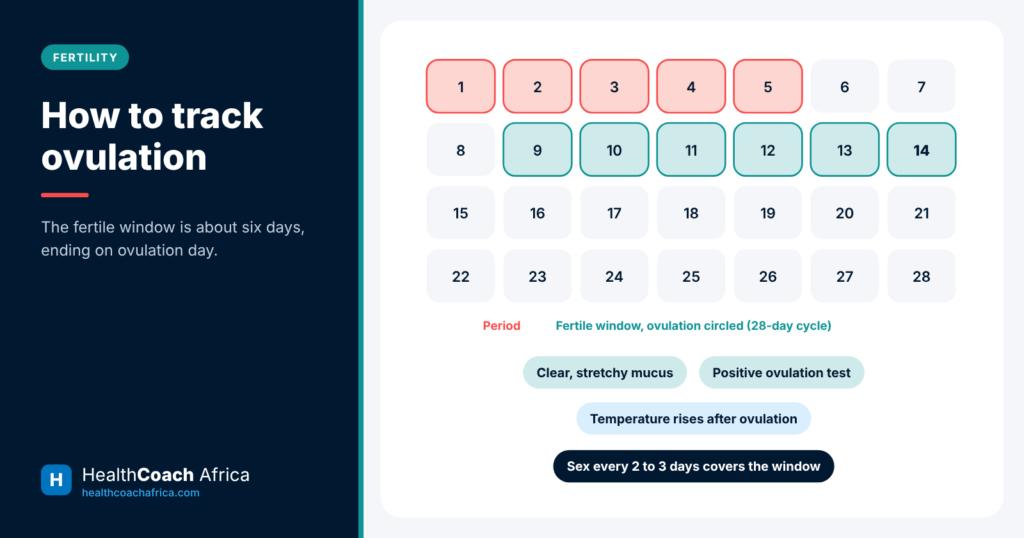
In a regular 28-day cycle, ovulation usually happens around day 14, counting the first day of your period as day 1. But cycles vary. In a 35-day cycle, ovulation may be around day 21. Ovulation usually happens about 14 days before the next period starts, not 14 days after the last one.
The fertile window
The fertile window is the six days ending on the day of ovulation. It includes the five days before ovulation and the day itself. Having sex every two to three days throughout the cycle covers the fertile window without needing exact timing. Tracking helps couples who want to focus on the best days.
Method 1: Track your cycle on a calendar
Record the first day of each period for at least three months. Count the length of each cycle. Then:
Find your shortest cycle and subtract 18 to estimate the first fertile day.
Find your longest cycle and subtract 11 to estimate the last fertile day.
Phone apps can do these calculations for you. Calendar tracking works best for women with regular cycles. It is less reliable if cycles vary a lot.
Method 2: Watch your cervical mucus
Cervical mucus changes through the cycle. Learning how to track ovulation through mucus is free and can be very useful:
After your period: little mucus, with a dry feeling
Approaching ovulation: mucus becomes creamy, then wetter
Around ovulation: clear, slippery and stretchy, like raw egg white
After ovulation: mucus becomes thick and sticky again, or dries up
The last day of clear, stretchy mucus is usually close to ovulation. Check mucus daily by wiping with clean tissue before passing urine.
Method 3: Ovulation predictor kits
Ovulation kits1 test urine for the LH surge that happens 24 to 36 hours before ovulation. They are sold in pharmacies.
Start testing a few days before you expect to ovulate.
Test at the same time each day, usually in the afternoon.
A positive result means ovulation is likely within the next one to two days.
Have sex on the day of a positive test and the following day.
Kits are easy to use, but they can give misleading results in women with polycystic ovary syndrome, who may have high LH levels.
HUBPHARM PHARMACIST’S NOTE
Ovulation kits are easy to misread, and cheap unregistered tests can give false positives. Message a HubPharm pharmacist for genuine ovulation kits, a sensitive basal thermometer and folic acid. Send us a photo of a test strip if you are unsure about a faint line, and we will help you read it. If your cycles are irregular or you have been trying for a while, we will help you prepare a short cycle summary to take to your doctor, so that tests can start sooner.
Method 4: Basal body temperature
Your resting body temperature rises slightly, by about 0.2 to 0.5°C, after ovulation. To track it:
Use a sensitive digital thermometer2
Take your temperature every morning before getting out of bed
Record it on a chart
A temperature rise that lasts at least three days suggests ovulation has happened. This method confirms ovulation after the event, so it helps you learn your pattern over several cycles rather than predict the day.
Other signs of ovulation
Some women notice:
Mild pain or twinges on one side of the lower belly
Breast tenderness
Increased sex drive
Light spotting
These signs vary and are not reliable on their own, but they can support other methods.
How to track ovulation with a phone app
Many women use period-tracking apps. Apps are useful for recording periods, mucus and test results in one place. However, apps that only use cycle dates are estimates. They work less well if your cycles vary. For the best results, enter your mucus observations and ovulation test results, not just period dates. Treat the predicted fertile days as a guide, not a guarantee.
How to track ovulation after stopping contraception
After stopping the pill, cycles usually return within a few weeks to months. After the contraceptive injection, it can take longer, sometimes up to a year, for regular ovulation to return. During this time, watching cervical mucus and using ovulation kits help you see when ovulation restarts. If periods do not return within a few months of stopping the pill, or within a year after the injection, see a doctor.
Combining methods
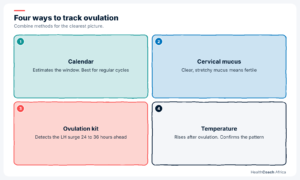
Comparison of four methods showing how to track ovulation: calendar, mucus, ovulation kits and temperature
Regular sex every two to three days also covers the fertile window.
Many women learn how to track ovulation best by combining methods. For example, use a calendar app to estimate the fertile window, watch mucus changes as it approaches and use an ovulation kit to pinpoint the surge. A temperature chart then confirms that ovulation happened.
Lifestyle habits that support ovulation
Keep a healthy weight, as both low and high weight can disrupt ovulation
Eat a balanced diet with vegetables, whole grains, beans and fish
Take folic acid daily while trying3 to conceive
Limit alcohol and stop smoking
Manage stress with rest, exercise and support
Avoid very intense exercise without enough food
When cycles are irregular
Irregular cycles can make ovulation harder to predict and may be a sign of an underlying problem, such as:
Polycystic ovary syndrome (PCOS)
Thyroid problems
High prolactin levels
Being underweight or overweight
Stress or very intense exercise
If your cycles are shorter than 21 days, longer than 35 days or very unpredictable, see a doctor. Tests can check whether you are ovulating.
Medical tests for ovulation
Doctors can confirm ovulation with:
A day 21 progesterone blood test (adjusted for cycle length), taken about seven days before your expected period
Ultrasound tracking, which follows a growing follicle in the ovary until it releases an egg
These tests are often used before fertility treatment.
How to track ovulation as a couple
Tracking works best when both partners are involved. Share your chart or app with your partner, so you can plan together. Men can support by reducing alcohol, stopping smoking and having a semen analysis if conception takes longer than expected. Learning how to track ovulation together turns a lonely task into a shared plan.
Do not let tracking cause stress
Tracking can become stressful, especially after months of trying. Sex only on “fertile days” can put pressure on both partners. Remember that regular sex every two to three days works well too. Keep tracking simple and talk openly with your partner.
When to seek help
See a doctor together if:
You are under 35 and have been trying for 12 months
You are 35 or older and have been trying for six months
You have irregular or absent periods
You have a history of pelvic infection, endometriosis or surgery
Your partner has known fertility concerns
Both partners should be assessed, because male factors play a part in many cases.
Detect the LH surge 24 to 36 hours before ovulation.
2
Basal body thermometer
Over the counter
Sensitive thermometer for daily temperature charts.
3
Folic acid
Over the counter
Daily while trying to conceive.
To order any of these, or to ask a pharmacist a question first, message HubPharm on WhatsApp or visit hubpharmafrica.com. Prescription medicines are supplied against a valid prescription.
How to Track Ovulation: Find Your Most Fertile Days For couples trying for a baby, timing matters. A woman can only get pregnant on a few days in each cycle, around the time an egg is released. Knowing when those days fall can make…
Tips for Healthy Sperm: How Men Can Improve Their Fertility When a couple struggles to conceive, the woman is often blamed first. Yet male factors contribute to many cases of infertility. Sperm health depends on general health, lifestyle and medical conditions, and much of it…
Getting Pregnant After 35: What You Need to Know More women are having children later in life, after completing their education, building careers or finding the right partner. Getting pregnant after 35 is very common, and many women have healthy pregnancies and babies. However,…
IVF Treatment in Nigeria: A Step-by-Step Guide for Couples Infertility affects many Nigerian couples and often brings stress, stigma and family pressure. In vitro fertilisation, or IVF, has helped many of these couples to have children. The number of fertility clinics in Nigeria has…