Family planning allows women and couples to decide whether and when to have children, and how many. It improves the health of mothers and babies, supports education and careers, and strengthens families. Yet many Nigerians are unsure which method suits them, or are put off by myths about side effects. This guide explains the main contraceptive options in Nigeria, how well they work and how to choose.
Why family planning matters
According to the World Health Organization, access to contraception reduces unintended pregnancies, unsafe abortions and deaths related to pregnancy. Spacing births at least two years apart improves the health of both mother and child.
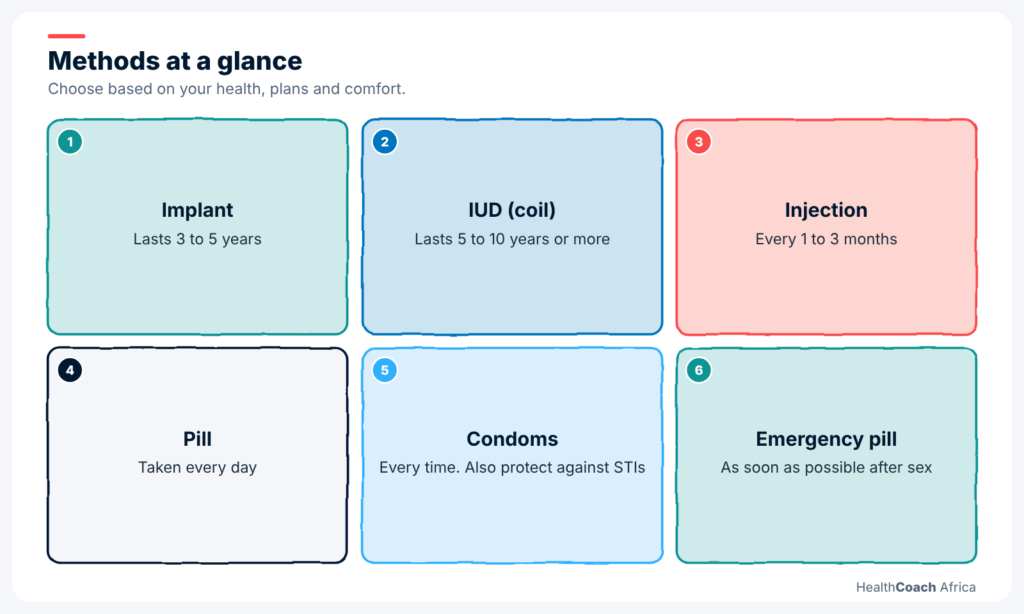
Contraceptive options in Nigeria at a glance
Implant: a small rod in the arm. Lasts three to five years.
Copper IUD: no hormones. Lasts ten years or more.
Hormonal IUD: lighter periods. Lasts several years.
Injection: every two or three months.
Pill: one tablet every day.
Condoms: used every time you have sex. Also protect against infections.
Sterilisation: permanent.
This quick list helps you compare contraceptive options in Nigeria before you speak to a health worker.
Overview of contraceptive options in Nigeria and how long each method lasts
A trained health worker can help you choose the method that suits you best.
How effective is each method?
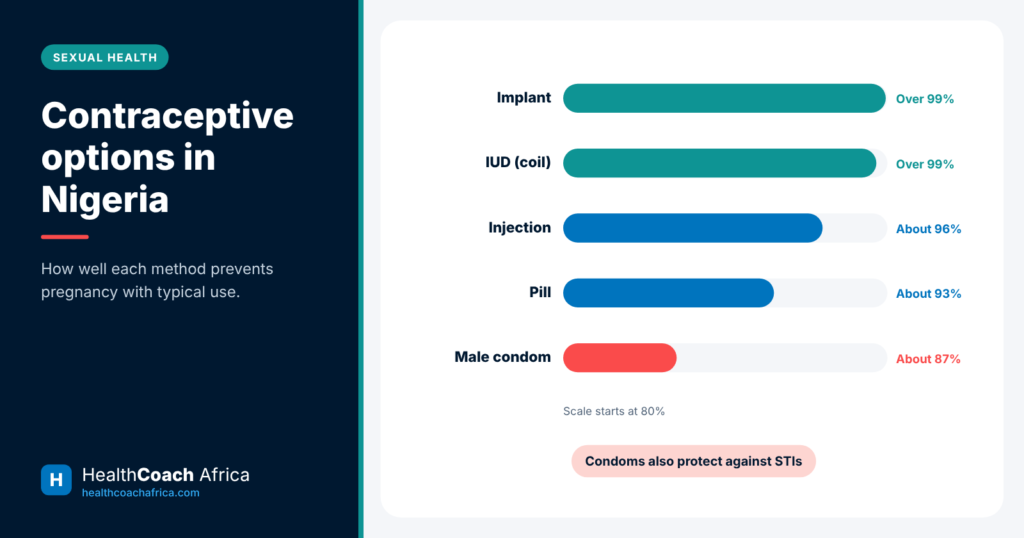
Contraceptive methods differ greatly in how well they prevent pregnancy, especially with typical use, which includes occasional mistakes:
Most effective (fewer than 1 in 100 women get pregnant in a year): implants, intrauterine devices and sterilisation
Very effective with correct use: injections, which need a repeat dose on time
Effective with careful use: daily pills, the patch and the ring
Less effective: condoms, fertility awareness methods and withdrawal
Long-acting methods work well because they do not depend on remembering a daily pill or using something every time you have sex.
Contraceptive implants
An implant is a small, flexible rod placed under the skin of the upper arm. It releases a hormone that prevents ovulation. Depending on the type, it lasts three to five years. It can be removed at any time, and fertility returns quickly.
Common side effects include changes in bleeding patterns, such as irregular spotting or no periods. These are not harmful.
Intrauterine devices
An intrauterine device, or IUD, is a small T-shaped device placed in the womb by a trained provider.
The copper IUD contains no hormones and can last 10 years or more. It may make periods heavier or more painful at first. It can also be used as emergency contraception.
The hormonal IUD releases a small amount of hormone. It often makes periods lighter and less painful, and lasts several years depending on the type.
Injectable contraceptives
Injections contain a hormone that prevents ovulation. Options in Nigeria include injections given every two months or every three months. A self-injection option allows some women to inject themselves at home after training.
Side effects include irregular bleeding or no periods, and sometimes weight gain. Fertility can take several months to return after stopping, so injections may not suit women who want to conceive soon.
Oral contraceptive pills
Combined pills 1 contain oestrogen and progestogen. They are taken daily and can make periods lighter and more regular. They are not suitable for some women, including those with certain types of migraine, high blood pressure, a history of blood clots, or who smoke and are over 35.
Progestogen-only pills contain one hormone and are suitable for more women, including those who are breastfeeding.
Pills must be taken every day to work well.
HUBPHARM PHARMACIST’S NOTE Several common medicines, including some epilepsy medicines, rifampicin for TB and some HIV treatments, can make pills and implants less effective. Ask a HubPharm pharmacist to check your contraception against everything else you take. Pills, condoms and emergency contraception can be delivered discreetly.
Condoms
Male and female condoms 2 are the only methods that also protect against sexually transmitted infections, including HIV. They are widely available and have no hormonal side effects. Using condoms together with another method, known as dual protection, gives the best protection against both pregnancy and infections. Learn more in our article on condoms and safe sex.
Contraception after childbirth
Many women can become pregnant again sooner than they expect after giving birth, even before periods return. Spacing pregnancies by at least two years is healthier for mother and baby. Several methods can be started soon after birth. Progestogen-only pills, implants, injections and IUDs are generally safe while breastfeeding. Combined pills are usually avoided in the first weeks after birth. Discuss contraceptive options in Nigeria with your midwife before you leave the hospital or at your postnatal visit.
Exclusive breastfeeding can delay pregnancy for some women, but only if specific conditions are met: the baby is under six months, is fed only breast milk day and night, and periods have not returned. Once any of these change, use another method.
Natural methods
Fertility awareness methods involve tracking the menstrual cycle to avoid sex on fertile days. They need training, commitment and a regular cycle. Withdrawal is less reliable. These methods do not protect against infections.
Permanent methods
Female sterilisation, called tubal ligation, and male sterilisation, called vasectomy, are permanent methods for people who are sure they do not want more children. Vasectomy is a simpler and safer procedure than female sterilisation.
Emergency contraception
If you have unprotected sex or a method fails, emergency contraception can prevent pregnancy. Options include emergency pills 3 and the copper IUD. They work best when used as soon as possible.
Contraception and health conditions
Some health conditions affect which methods are safest:
High blood pressure: combined pills are often avoided. Progestogen-only methods and IUDs are usually suitable.
Migraine with aura: combined pills are not recommended.
Sickle cell disease: many methods are suitable, and some injections may reduce crises.
Epilepsy: some epilepsy medicines reduce the effect of pills and implants.
HIV treatment: some HIV medicines interact with hormonal methods.
Breastfeeding: progestogen-only methods and IUDs are preferred.
A health worker or pharmacist can check which contraceptive options in Nigeria are safe for you.
Managing side effects
Most side effects are mild and settle within a few months. Changes in bleeding are the most common. Irregular spotting with implants and injections is not harmful. If side effects bother you, do not simply stop. Speak to a health worker. Another method may suit you better. Stopping without a plan can lead to an unplanned pregnancy.
Where to get contraception
Family planning services are offered at public hospitals, primary health centres, private clinics and many pharmacies. Pills, condoms and emergency contraception are available from pharmacies. Implants, IUDs and injections are given by trained providers. Youth-friendly services welcome young people and respect confidentiality.
Choosing among contraceptive options in Nigeria
Consider these questions:
Do you want children in the future, and when?
Do you prefer a method you do not need to think about every day?
Are you breastfeeding?
Do you have health conditions such as high blood pressure, migraine or sickle cell disease?
Do you also need protection from infections?
How do you feel about changes in your periods?
A trained health worker can help you weigh these factors.
Myths about contraception
“Contraceptives cause infertility.” Fertility returns after stopping most methods. With injections, it may take a few months.
“Implants can move around the body.” Implants stay where they are placed under the skin.
“The coil causes cancer.” IUDs do not cause cancer.
“Only married women can use family planning.” Contraception is for anyone who wants to prevent pregnancy.
Getting help
There are many contraceptive options in Nigeria, and the right one is the one that suits your life and health. Family planning services are available at public health facilities, many of which provide methods free or at low cost. For pills, condoms, emergency contraception or advice on choosing a method, message a HubPharm pharmacist or chat with Afiya on WhatsApp in confidence.
Medicines and products in this article
#
Medicine or product
What to know
1
Combined and progestogen-only pills
Pharmacy or prescription
Daily tablets. Check suitability with a health worker.
2
Condoms
Over the counter
Protect against pregnancy and STIs.
3
Emergency contraceptive pill
Pharmacy medicine
Use as soon as possible after unprotected sex.
To order any of these, or to ask a pharmacist a question first, message HubPharm on WhatsApp or visit hubpharmafrica.com. Prescription medicines are supplied against a valid prescription.
Emergency Contraception in Nigeria: Pills, Timing… A condom breaks. A pill is forgotten. Sex happens without protection, or without consent. In each case, there is still a short window in which pregnancy can be prevented. Emergency contraception in Nigeria is legal,…
Preparing for Pregnancy Checklist: A Healthy Start… The months before pregnancy are an important time to prepare. Many of a baby's organs form in the first weeks, often before a woman knows she is pregnant. Good health before conception lowers the risk…
Malaria Prevention in Pregnancy: Protecting Mother and Baby Pregnancy changes the body's defences, and malaria takes advantage of this. In Nigeria, where malaria is present all year round, pregnant women face a higher risk of infection and of serious complications. Fortunately, simple and…
Heart Failure After Pregnancy: Recognising… Most new mothers feel tired and breathless at times. Pregnancy and caring for a newborn are physically demanding. However, for a small number of women, these symptoms are signs of a serious heart condition called…