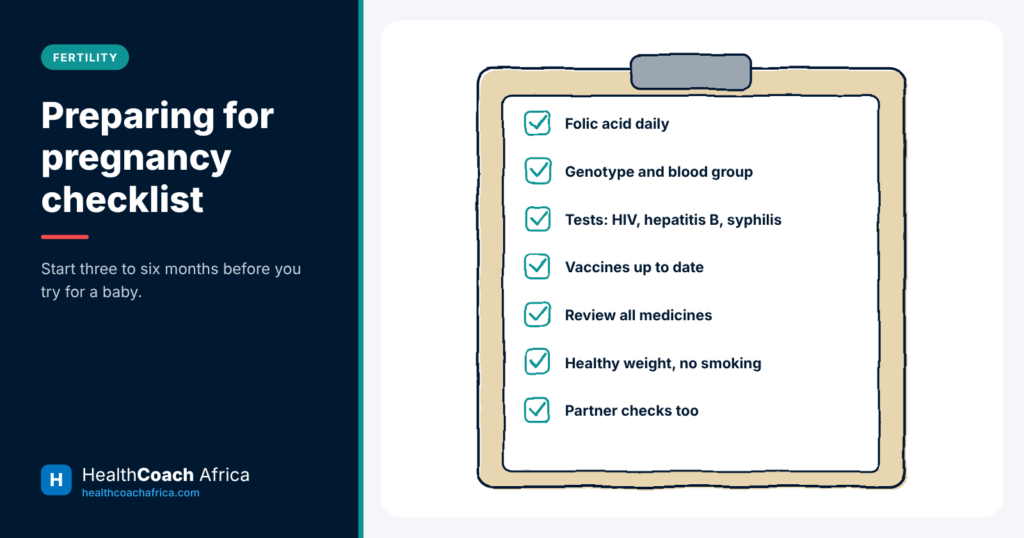
The months before pregnancy are an important time to prepare. Many of a baby’s organs form in the first weeks, often before a woman knows she is pregnant. Good health before conception lowers the risk of miscarriage, birth defects and pregnancy complications. This preparing for pregnancy checklist covers the key steps for you and your partner, ideally starting three months or more before you try.
Why use a preparing for pregnancy checklist?
Many pregnancies are unplanned, and many women only see a health worker after they realise they are pregnant. By then, the most important weeks of the baby’s development may have passed. Using a preparing for pregnancy checklist helps you act early. Even if you are not planning a pregnancy right now, many of these steps, such as folic acid and good control of long-term conditions, are worth taking if pregnancy is possible.
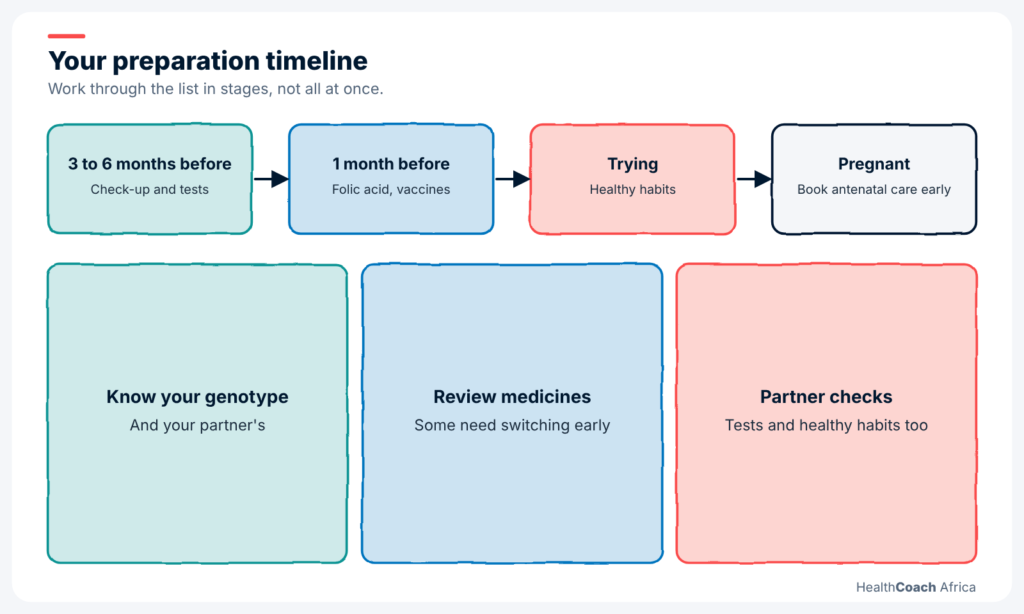
Timeline for working through a preparing for pregnancy checklist
Start folic acid at least one month before you stop contraception.
1. Start folic acid
Folic acid helps prevent serious birth defects of the baby’s brain and spine, called neural tube defects. Take 400 micrograms daily 1 , starting at least one month before trying and continuing until 12 weeks of pregnancy. Some women need a higher dose of 5 mg, including those with diabetes, sickle cell disease, epilepsy on certain medicines, obesity, or a previous baby with a neural tube defect. Ask your doctor.
2. Know your genotype
In Nigeria, knowing your haemoglobin genotype, and your partner’s, is essential. If both partners carry the sickle cell trait (AS), each pregnancy has a one in four chance of a child with sickle cell disease (SS). Knowing in advance allows informed decisions and early care.
3. Check your blood group
Your blood group and rhesus status matter. If you are rhesus negative, you may need injections during pregnancy to protect future babies.
4. Test for infections
Some infections can affect pregnancy or be passed to the baby. Ask about testing for:
HIV
Hepatitis B
Syphilis
Other sexually transmitted infections
Many of these can be treated or managed to protect your baby.
5. Check your vaccines
Make sure you are protected against rubella, which can cause serious birth defects if caught in early pregnancy. Some vaccines must be given at least one month before conception. Check your hepatitis B and tetanus vaccination status too.
HUBPHARM PHARMACIST’S NOTE A pre-pregnancy medicine review is one of the most valuable checks you can do. Some common medicines need switching months before conception. Book a free preconception medicine review with a HubPharm pharmacist. Send both partners’ medicine lists, and we will flag anything to discuss with your doctor.
6. Review your medicines
Some medicines can harm a developing baby. These include certain epilepsy medicines such as valproate, some blood pressure medicines such as ACE inhibitors, warfarin, isotretinoin for acne and some herbal products. Do not stop any medicine suddenly. Ask your doctor or pharmacist to review everything you take, so that safer options can be planned.
7. Manage long-term conditions
If you have diabetes, high blood pressure, thyroid disease, epilepsy, sickle cell disease, asthma or heart disease, see your doctor before trying. Good control before conception reduces risks. For example, high blood sugar in early pregnancy increases the risk of birth defects.
8. Reach a healthy weight
Being very underweight or overweight can make it harder to conceive and increase pregnancy risks. Even modest weight loss in women who are overweight improves fertility and pregnancy outcomes.
9. Eat well
A balanced diet with vegetables, fruit, whole grains, beans, fish, eggs and dairy provides important nutrients. Eat iron-rich foods such as beans, green leafy vegetables and lean meat. Use iodised salt in moderation. Limit sugary drinks and processed foods.
10. Stop smoking and avoid alcohol
Smoking reduces fertility and increases the risk of miscarriage, premature birth and low birth weight. There is no known safe level of alcohol in pregnancy. Stopping before you try is best. Avoid recreational drugs completely.
11. Look after your mental health
Pregnancy and parenthood bring big changes. If you have a history of depression or anxiety, talk to your doctor before pregnancy so that support and safe treatment can be planned.
Preparing for pregnancy checklist for women with sickle cell disease
Women with sickle cell disease can have healthy pregnancies, but they need specialist care. Before conception, review medicines such as hydroxyurea, which may need to be stopped. Take a higher dose of folic acid, usually 5 mg. Make sure vaccines are up to date. Plan to attend a hospital with obstetricians and haematologists experienced in sickle cell pregnancy. Pregnancy increases the risk of crises, infections and blood clots, so close monitoring is essential.
Preparing for pregnancy checklist for women with diabetes
High blood sugar in early pregnancy increases the risk of birth defects and miscarriage. Women with diabetes should aim for good blood sugar control before trying, with an HbA1c target set by their doctor. Take 5 mg folic acid. Have an eye and kidney check. Some diabetes medicines may need to be changed to insulin or other options that are safe in pregnancy.
12. Involve your partner
Men’s health affects fertility and pregnancy too. Partners should:
Know their genotype and HIV status
Stop smoking and limit alcohol
Maintain a healthy weight
Treat any infections
Review medicines, including anabolic steroids
Work and environment
Some jobs involve exposure to chemicals, radiation, heavy lifting or infections that can affect pregnancy. If your work involves any of these, talk to your employer and doctor about adjustments. Avoid handling pesticides and strong chemicals at home where possible. Cat litter and undercooked meat can carry toxoplasmosis, an infection that can harm the baby, so wear gloves and cook meat thoroughly.
Dental and general check-up
Gum disease has been linked to pregnancy complications. Visit a dentist before pregnancy if you can. A general check-up with your doctor, including blood pressure and blood tests, is also a good idea.
Questions to ask at a pre-pregnancy visit
Which tests do I and my partner need before trying?
Do I need a higher dose of folic acid?
Are any of my medicines unsafe in pregnancy?
Are my vaccines up to date?
How well controlled is my long-term condition?
How soon after stopping contraception can we try?
Caffeine, herbs and supplements
Limit caffeine to about 200 mg a day, roughly two cups of coffee. Check herbal teas and supplements with a pharmacist, because some are not safe in pregnancy. Avoid high-dose vitamin A. A simple prenatal vitamin 2 with folic acid, iodine and vitamin D is usually enough for most women.
After stopping contraception
Fertility usually returns quickly after stopping the pill, implant or coil. After the contraceptive injection, it can take several months for periods and ovulation to return. Plan ahead if you use the injection. Track your periods once they return, and keep taking folic acid while you try.
Using this preparing for pregnancy checklist
Print or save this preparing for pregnancy checklist and tick off each step. Take it to your doctor or pharmacist so that nothing is missed. Share it with your partner, because many steps apply to both of you. Starting three months before you try gives enough time to complete the tests, update vaccines and adjust medicines.
Know your cycle
Tracking your periods helps you understand your fertile window and date your pregnancy accurately. Note the first day of each period in a diary or app.
A simple timeline
Three to six months before: book a pre-pregnancy check, review medicines and test for infections.
At least one month before: start folic acid, stop smoking and alcohol, and update vaccines.
When you start trying: track your cycle and keep up healthy habits.
Following a preparing for pregnancy checklist in stages makes it easier to manage.
Prevents neural tube defects. Higher dose for some women.
2
Prenatal vitamins
Over the counter
Simple formula with folic acid, iodine and vitamin D.
To order any of these, or to ask a pharmacist a question first, message HubPharm on WhatsApp or visit hubpharmafrica.com. Prescription medicines are supplied against a valid prescription.
Getting Pregnant After 35: What You Need to Know More women are having children later in life, after completing their education, building careers or finding the right partner. Getting pregnant after 35 is very common, and many women have healthy pregnancies and babies. However,…
Malaria Prevention in Pregnancy: Protecting Mother and Baby Pregnancy changes the body's defences, and malaria takes advantage of this. In Nigeria, where malaria is present all year round, pregnant women face a higher risk of infection and of serious complications. Fortunately, simple and…
Causes of Secondary Infertility: When the Second… Many couples assume that if they had one child easily, the next pregnancy will follow just as easily. When it does not, they can feel confused, frustrated and even guilty. Secondary infertility means difficulty getting…
Gestational Diabetes in Pregnancy: What Every Mother… Gestational diabetes is high blood sugar that develops during pregnancy in a woman who did not have diabetes before. It is becoming more common in Nigeria as more women enter pregnancy overweight or at an…