Insulin is a life-saving medicine for people with type 1 diabetes and many people with type 2 diabetes. Yet the way insulin is injected can make a big difference to how well it works. Poor technique can lead to unpredictable blood sugar, painful lumps under the skin and wasted insulin. These insulin injection technique tips will help you inject safely, comfortably and effectively.
Types of insulin
There are several types of insulin, and each works over a different time:
Rapid-acting 1 insulin starts working within about 15 minutes and is taken just before meals
Short-acting (regular) insulin starts in about 30 minutes and is taken about half an hour before meals
Intermediate-acting insulin, often cloudy, works over about 12 hours
Long-acting insulin provides steady background cover for about a day
Premixed insulin combines short- and intermediate-acting insulin
Know the name and type of each insulin you use, and when to take it.
Pens or syringes?
Insulin can be given with a syringe and vial or with a pen. Pens are easier to use, more accurate for small doses and more discreet. Syringes are often cheaper. Make sure the syringe matches the strength of your insulin. In Nigeria, most insulin is U-100, which must be used with U-100 syringes. Using the wrong syringe can lead to a dangerous dose error.
Insulin injection technique tips for children
Children can find injections frightening. Stay calm and confident. Use short needles and inject quickly. Let older children choose the site within the plan, which gives them some control. Distraction with a song, a game or a favourite video helps younger children. Praise them afterwards. Over time, many children learn to inject themselves. These insulin injection technique tips apply to them too, especially site rotation.
Where to inject
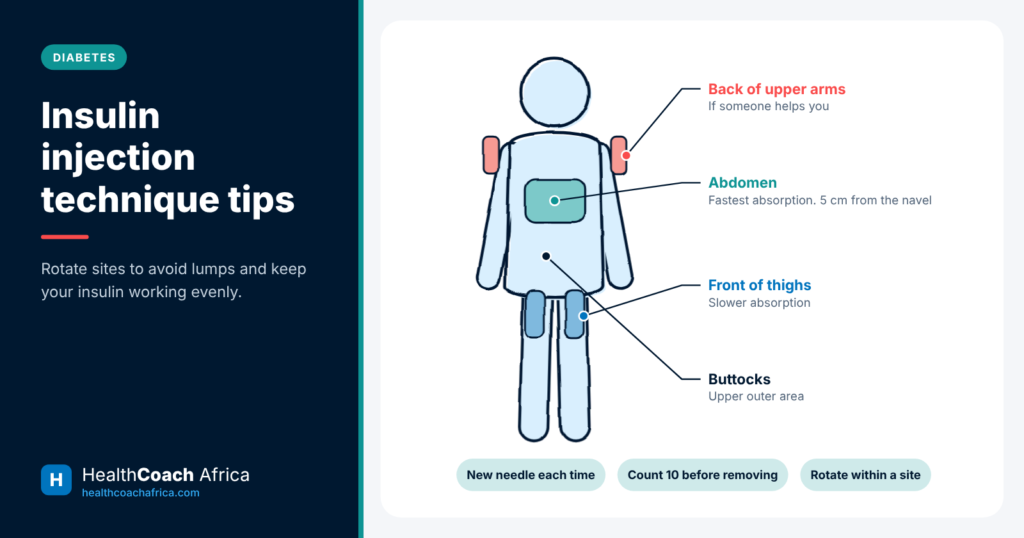
Insulin is injected into the fatty layer just under the skin. The main sites are:
Abdomen: at least two finger-widths away from the navel. Insulin is absorbed fastest here.
Front and outer thighs: absorption is slower, which suits long-acting insulin.
Buttocks: the upper outer area, also slower absorption.
Back of the upper arms: harder to reach yourself.
Avoid areas with scars, moles, bruises or lumps.
Rotate your injection sites
One of the most important insulin injection technique tips is rotation. Injecting into the same spot again and again causes lumps of fatty tissue, called lipohypertrophy. Insulin injected into these lumps is absorbed unpredictably, causing high and low blood sugar.
Divide each site into sections and move around in a regular pattern. Keep each injection at least one finger-width from the last. Use the same body area at the same time of day, for example the abdomen for breakfast doses, but rotate within that area.
Check for lumps
Once a month, look at and feel your injection sites. Lumps may feel rubbery, firm or swollen. If you find one, avoid that area until it softens, which can take months. Tell your diabetes team, because your dose may need adjusting when you move to healthy skin.
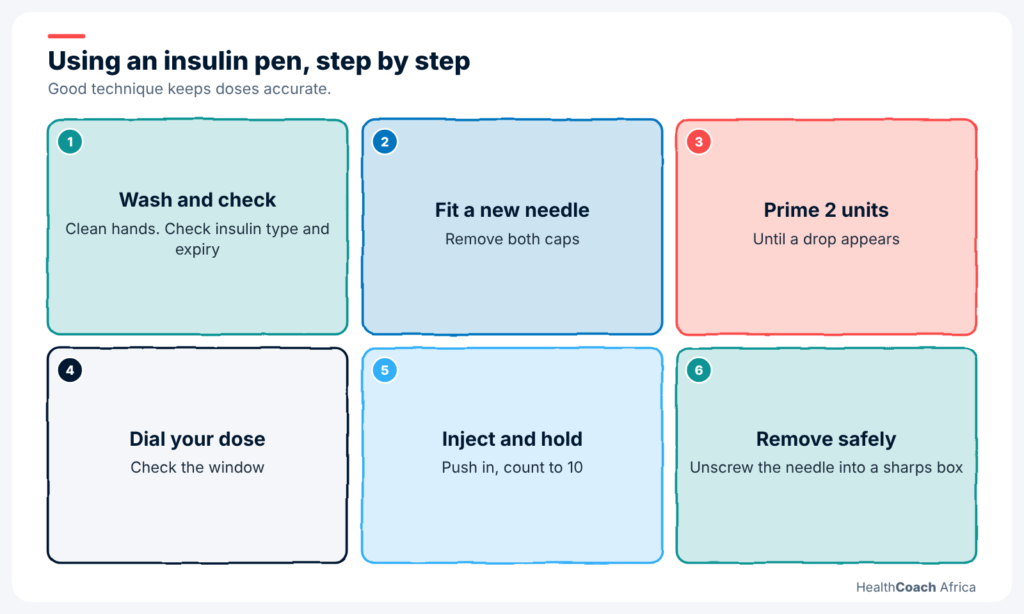
Step-by-step with an insulin pen
Wash your hands.
If the insulin is cloudy, roll the pen gently between your palms and tip it up and down about ten times until evenly mixed. Do not shake hard.
Attach a new needle.
Do a safety test, also called priming: dial two units, hold the pen upright and press until a drop appears.
Dial your dose.
Insert the needle straight in, at 90 degrees, into clean skin.
Press the button fully and hold for a slow count of ten before removing the needle.
Remove and safely dispose of the needle.
Six-step insulin pen guide with insulin injection technique tips
Use a new needle each time and rotate within your chosen site.
Step-by-step with a syringe
Wash your hands and roll the vial if the insulin is cloudy.
Wipe the vial top with alcohol.
Draw air into the syringe equal to your dose and inject it into the vial.
Turn the vial upside down and draw up your dose.
Remove air bubbles by tapping the syringe and pushing them out.
Inject into clean skin, push the plunger fully and wait a few seconds before withdrawing.
Needle length and pinching
Short needles 2 of 4 mm or 5 mm are suitable for most adults and children and reduce the risk of injecting into muscle. With these needles, most adults do not need to pinch the skin. Very slim adults and young children may need a gentle pinch. Injecting into muscle makes insulin act faster and can cause low blood sugar.
Common mistakes to avoid
Injecting into the same spot every time
Injecting through clothing
Pulling the needle out too quickly, so some insulin leaks
Forgetting to mix cloudy insulin
Skipping the safety test on a pen
Using insulin that has been left in the sun
Using the wrong type of syringe
Fixing these common mistakes can improve blood sugar control without changing your dose. Review your insulin injection technique tips with your nurse at least once a year.
Use each needle once
Reusing needles is common, often to save money. However, used needles become blunt and bent, cause more pain and increase the risk of lumps and infection. Use a new needle for every injection whenever possible.
HUBPHARM PHARMACIST’S NOTE Every insulin pen HubPharm supplies travels in a verified cold chain, from the supplier to your door, with cool packs. Order insulin, pen needles and a cool bag from HubPharm, and ask a pharmacist to watch your technique on a short video call. Small fixes can steady your readings.
Storing insulin in a hot climate
Heat damages insulin and makes it less effective. Store unopened insulin in the fridge at 2 to 8°C, never in the freezer. The pen or vial you are using can usually be kept at room temperature, below about 25 to 30°C depending on the product, for about four weeks. Check the leaflet.
During power cuts or travel, use a cool box, an insulated bag with cool packs, or a clay pot cooler. Never leave insulin in a car or in direct sunlight. Do not use insulin that looks lumpy, discoloured or frosted.
Safe disposal of sharps
Put used needles and syringes in a hard plastic container 3 with a lid, such as an empty detergent bottle. When it is full, seal it and ask your clinic or pharmacy how to dispose of it safely. Never throw loose needles in household rubbish.
Travelling with insulin
When travelling, keep insulin in your hand luggage, not in a hot car boot or checked baggage. Use a cool bag. Carry extra needles, a glucose meter, snacks and a letter from your doctor. Plan injection times around long journeys and time changes. Keep a fast sugar source within reach at all times.
Insulin injection technique tips when you are unwell
Illness often raises blood sugar, even if you are eating less. Never stop insulin on your own. Check your blood sugar more often. Drink plenty of fluids. Contact your doctor if your readings stay high, you cannot keep fluids down or you feel very unwell.
Avoiding low blood sugar
Take mealtime insulin at the right time and eat your meal. Carry a fast sugar source, such as glucose tablets or a small soft drink, at all times. Teach family members the signs of low blood sugar. These insulin injection technique tips work best alongside regular blood sugar checks.
Checking your technique
Ask a nurse or pharmacist to watch you inject once a year. Bring your pen or syringe and your insulin. Show your sites. Small adjustments, such as a shorter needle or better rotation, can smooth out your readings and reduce lumps.
Short needles reduce the risk of injecting into muscle. Use a new one each time.
3
Sharps container
Over the counter
Safe disposal of used needles.
To order any of these, or to ask a pharmacist a question first, message HubPharm on WhatsApp or visit hubpharmafrica.com. Prescription medicines are supplied against a valid prescription.
Childhood Type 1 Diabetes: A Guide for Nigerian Families Many people think diabetes only affects older, overweight adults. However, children can develop diabetes too, and most children with diabetes have type 1. In Nigeria, childhood type 1 diabetes is often missed until the child…
Nigerian Diet for Diabetes: A Practical Guide to Eating Well A diagnosis of diabetes often comes with a long list of foods you are told to stop eating. Many people believe they must give up eba, rice, yam and plantain for ever. That is not…
Low Blood Sugar Symptoms: Warning Signs and What to Do Fast Most conversations about diabetes focus on high blood sugar. Yet for people who use insulin or certain tablets, the more immediate danger is sugar that drops too low. Low blood sugar symptoms can progress from…
Gestational Diabetes in Pregnancy: What Every Mother… Gestational diabetes is high blood sugar that develops during pregnancy in a woman who did not have diabetes before. It is becoming more common in Nigeria as more women enter pregnancy overweight or at an…