Lassa fever is a viral illness that is found in West Africa, and Nigeria reports more cases than any other country. Each year, outbreaks peak during the dry season, from about December to April. In 2025, the Nigeria Centre for Disease Control reported that roughly one in six people with confirmed Lassa fever died. Many of those deaths happened because people reached treatment late. Knowing the Lassa fever warning signs, and acting early, can save your life.
What causes Lassa fever
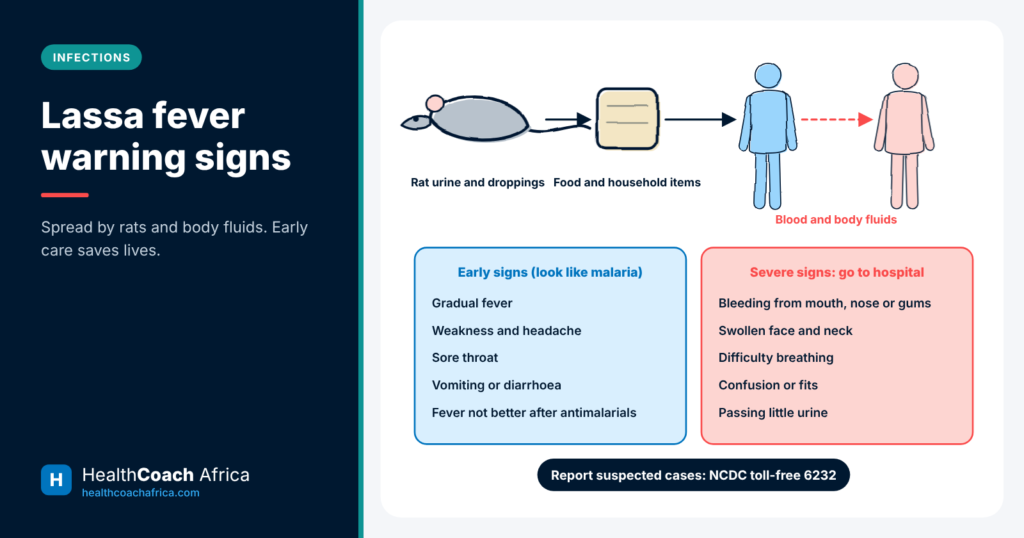
Lassa fever is caused by the Lassa virus. Its natural host is the multimammate rat, a common rodent found in homes, farms and food stores across West Africa. Infected rats do not become ill, but they pass the virus in their urine and droppings.
People catch Lassa fever by:
Eating food or drinking water contaminated with rat urine or droppings
Touching contaminated surfaces or household items and then the mouth, nose or eyes
Breathing in dust contaminated by rat droppings
Catching and eating infected rats
The virus can also pass from person to person through blood, urine, vomit, saliva and other body fluids. This is why health workers and family members caring for sick relatives are at risk.
Where and when it occurs
Cases have been reported in many Nigerian states. In recent years, Ondo, Edo, Bauchi and Taraba have reported the largest numbers. However, cases can occur anywhere people travel. The dry season brings more cases, partly because rats move into homes in search of food after harvest and bush burning.
Early Lassa fever warning signs
Symptoms usually start between 3 and 21 days after infection. In the beginning, Lassa fever looks very much like malaria or typhoid. Early signs include:
Fever that rises gradually
General weakness and tiredness
Headache
Sore throat
Muscle pain
Cough
Nausea, vomiting or diarrhoea
Chest or abdominal pain
Because these signs are so common, Lassa fever is easy to miss. About 80% of people infected have mild symptoms or none at all. However, the rest can become seriously ill.
Signs of severe illness
As the illness progresses, more serious Lassa fever warning signs can appear:
Bleeding from the mouth, nose, gums, eyes or vagina, or blood in vomit or stool
Swelling of the face and neck
Difficulty breathing
Confusion, tremors or seizures
Reduced urine output
Shock
These signs need emergency treatment. Pregnant women are at particularly high risk of severe illness and of losing the pregnancy.
The fever that does not respond to malaria treatment
One of the most important Lassa fever warning signs is a fever that does not improve after a full course of antimalarial treatment, or after antibiotics for suspected typhoid. If you or a family member still have a fever after two to three days of treatment, especially in the dry season or in a high-risk area, ask the health worker about testing for Lassa fever.
Anyone in an area with Lassa fever can be infected. However, the risk is higher for:
People who live in homes with rats, especially in rural areas
Farmers and people who handle and store grain
Family members caring for a sick relative without protection
Health workers who treat patients without gloves and other protection
People who hunt, handle or eat rodents
Pregnant women face a higher risk of severe illness, so they should seek care quickly for any fever. Knowing the Lassa fever warning signs is especially important for these groups.
Testing and treatment
Lassa fever is confirmed with a laboratory test on a blood sample. Nigeria has a network of testing laboratories and treatment centres. If a case is suspected, the health facility will contact the state or national surveillance team.
Treatment includes an antiviral medicine called ribavirin 1 , which works best when started early in the illness. Supportive care, such as fluids, oxygen, blood transfusion and treatment of complications, is just as important. Many people recover fully with early care.
HUBPHARM PHARMACIST’S NOTE If a fever has not improved after a full course of antimalarials, do not buy a second course or a stronger antibiotic. Message a HubPharm pharmacist and tell us how long you have had the fever and what you have taken. We will direct you to the nearest facility that can test for Lassa fever. Time matters with this illness, so please do not wait.
Living after Lassa fever
Some survivors develop hearing loss, which can be permanent. Tell the doctor if your hearing changes during or after the illness. In addition, the virus can remain in semen for several months after recovery. Male survivors should use condoms until tests show that the virus has cleared, as advised by their doctor.
Protecting your home from rats
Preventing contact with rats is the best way to avoid Lassa fever. The Nigeria Centre for Disease Control advises:
Keep your home and surroundings clean
Store grains, garri and other foods in sealed, rodent-proof containers
Do not dry food on the ground or by the roadside
Cover bins and dispose of rubbish far from the home
Block holes in walls, doors and roofs
Use traps or other safe methods to remove rats
Avoid bush burning, which drives rats into homes
Wash hands regularly with soap and water
Never eat rats, and avoid handling dead rodents with bare hands.
House diagram with six rodent-proofing steps that lower the risk behind Lassa fever warning signs
Keeping rats away from food and living spaces is the most effective way to prevent Lassa fever.
A note for health workers
Lassa fever is a leading cause of infection among health workers in Nigeria during outbreaks. Treat every patient with fever as potentially infectious until proven otherwise. Use gloves for any contact with blood or body fluids, wash hands between patients and dispose of sharps safely. When Lassa fever is suspected, isolate the patient and use full protective equipment. Report suspected cases early to the local surveillance officer. Recognising Lassa fever warning signs in a patient who has not improved on malaria or typhoid treatment is one of the most important clinical skills during the dry season.
Myths about Lassa fever
“Only people who eat rats get Lassa fever.” Most people are infected through contaminated food or household items.
“Lassa fever always causes bleeding.” Bleeding happens only in some severe cases. Most patients first have ordinary-looking fever, which is why Lassa fever warning signs are easily missed.
“There is no treatment.” Early treatment with ribavirin and supportive care improves survival.
“Lassa fever only happens in villages.” Cases are reported in cities too, and patients often travel for care. Urban homes with rats, poor waste disposal and food stored openly carry the same risk.
Caring for a sick person safely
If someone at home has a fever that could be Lassa fever, take them to a health facility quickly. Avoid direct contact with their blood, vomit, urine and other body fluids. Wear gloves 2 if you must clean up, and wash your hands thoroughly afterwards. Do not share cutlery, towels or bedding until a diagnosis is made.
Health workers should use standard precautions with every patient, including gloves and hand hygiene, and full protective equipment when Lassa fever is suspected.
Reporting a suspected case
If you suspect Lassa fever, contact your nearest health facility or call the Nigeria Centre for Disease Control toll-free line on 6232. Early reporting helps to trace contacts and stop the spread.
Getting help
Share the Lassa fever warning signs with your family, especially during the dry season. The WHO Lassa fever fact sheet has more information. If you have a fever that is not improving, do not keep switching medicines on your own. Message a HubPharm pharmacist for advice on where to get tested, or ask Afiya on WhatsApp.
Medicines and products in this article
#
Medicine or product
What to know
1
Ribavirin
Hospital use only
Antiviral medicine given at Lassa fever treatment centres. It works best when started early.
2
Hand sanitiser and gloves
Over the counter
For hand hygiene and for cleaning up body fluids when caring for a sick person.
To order any of these, or to ask a pharmacist a question first, message HubPharm on WhatsApp or visit hubpharmafrica.com. Prescription medicines are supplied against a valid prescription.
Centers for Disease Control and Prevention. Lassa fever.
Please follow and like us:
Views:21
Related Posts:
Nigeria’s Lassa Fever Deaths Reach 263 as Fatality… ABUJA, NIGERIA — Lassa fever has claimed 263 lives in Nigeria so far in 2026, with the case fatality rate rising significantly higher than levels recorded during the same period last year. According to epidemiological…
Nigeria Lassa Fever Fatalities Reach 268 as Health… ABUJA, NIGERIA — The ongoing lassa fever outbreak in nigeria has claimed 268 lives through epidemiological week 40 of 2026, pushing the national case fatality rate (CFR) to 23.6 percent compared with 18.6 percent recorded…
Cholera Symptoms and Prevention: A Practical Guide… ARTICLE TEXT Cholera outbreaks occur in Nigeria almost every year, often during the rainy season when floods contaminate wells and boreholes. Cholera can kill within hours if dehydration is not treated. Yet it is easy…
Hepatitis B in Nigeria: Testing, Vaccine and… Hepatitis B is a viral infection that attacks the liver, often silently, for decades. The World Health Organization's 2026 Global Hepatitis Report lists Nigeria among ten countries that together account for nearly 70% of deaths…