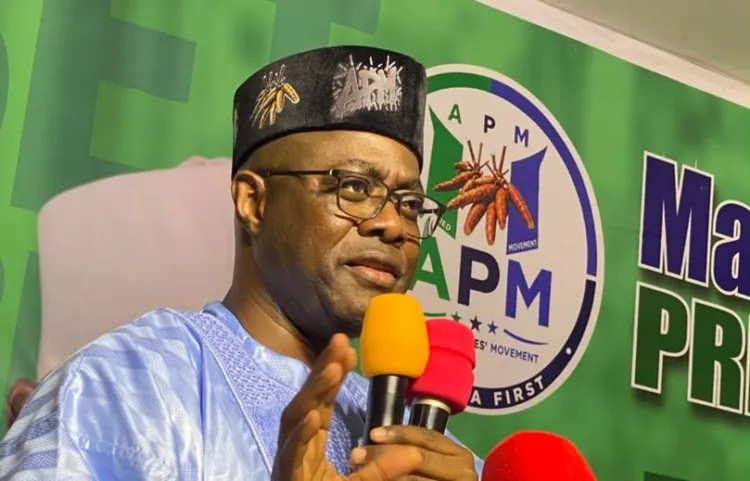
ABUJA, NIGERIA — Seyi Makinde, the 2027 presidential candidate of the Allied Peoples Movement (APM), has pledged an essential primary care guarantee agreed with states within his first year in office, according to his manifesto, Premium Times reported on 19 November.
“Within our first year, the federal government will agree with states on a published essential primary-care guarantee,” the manifesto says. It adds that “federal health funding will increasingly follow verified service delivery.”
How the essential primary care guarantee would work
The “RESET Nigeria Agenda” manifesto, unveiled on 4 November in Abuja, sets out a three-year framework, the report said. In year one, the government would agree the essential primary care guarantee and publish a verified baseline within the first 100 days. Year two would focus on funding verified services, health insurance and referrals, and year three on outcome targets.
The plan prioritises maternal care, childhood immunisation, emergency stabilisation and treatment of preventable diseases, and would use existing federal and state institutions to expand health insurance enrolment, Premium Times reported.
“No Nigerian should lose access to covered care merely because they move from one participating state to another,” the manifesto says.
The problems it identifies
The manifesto names poorly equipped facilities, direct payments by patients, weak referral systems and fragmented responsibilities as persistent problems. “Too many public healthcare facilities cannot provide dependable services,” it says. It notes that the Basic Health Care Provision Fund and the National Health Insurance Authority Act have not consistently produced dependable services.
The manifesto argues that clear standards are needed so that citizens know what services they can expect at their nearest health centre. An essential primary care guarantee would, in effect, set out a minimum package that every participating state commits to provide, with progress published against a baseline.
The report cited a 2026 assessment by Orodata Science and Civic Tech, which found that 97 per cent of 1,480 primary health care centres assessed across 16 states and 277 local government areas failed national minimum staffing requirements.
At the third Nigeria Health Sector Joint Annual Review, the Federal Ministry of Health reported that 3,526 primary health care centres had been revitalised, with work under way on another 900, according to the report.
Health on the 2027 agenda
Makinde, the Governor of Oyo State, is among the candidates setting out health plans ahead of the 2027 elections. HealthCoach Africa does not endorse any candidate, and other parties’ health proposals will be reported as they are published.
As general background, primary health care centres are meant to be the first point of contact for most Nigerians, providing antenatal care, deliveries, immunisation, treatment of common illnesses and screening for conditions such as hypertension and diabetes. When they lack staff, medicines or power, patients bypass them for crowded hospitals or turn to informal providers.
The idea of linking funding to verified services is not new. Results-based financing has been used in Nigerian programmes supported by the World Bank, which pay facilities according to the services they deliver and the quality of care. HealthCoach Africa has reported on World Bank support for new health centres in northern Nigeria.
Portability of insurance between states would address a common problem for people who move for work or family and lose access to state health insurance schemes.
As general background, Nigeria’s health insurance coverage has risen to nearly 24 million people, according to the health minister, but this is still a small share of a population of more than 200 million. Most Nigerians continue to pay for care out of pocket, which pushes many families into financial hardship when illness strikes.
Health workers are another constraint. With 97 per cent of assessed centres failing staffing requirements, according to the Orodata assessment cited in the report, any essential primary care guarantee would depend on recruiting, training and retaining nurses, midwives and community health workers in rural areas.
What voters can ask
Health analysts say voters can test any manifesto by asking how commitments will be funded, how progress will be measured and who will be accountable. The essential primary care guarantee proposal includes timelines and verification, but its costing and the role of states, which manage most primary health care, will be key questions.
With state health budgets now above N3.3 trillion, according to the health minister, the debate is increasingly about how money is spent rather than only how much is allocated.
Why it matters: Primary care is where most Nigerians first seek help, and the 2027 campaign is a chance to test candidates on how they would fix it.
Tinubu Pledges Stronger Primary Healthcare in… ABUJA, NIGERIA — Commemorating the nation’s 66th Independence anniversary, President Bola tinubu pledges stronger primary healthcare access for low-income citizens across Nigeria in an October 1 national broadcast. "Working with our states and local governments,…
Seven Organisations Pledge $65m to Cut Maternal and… ABUJA, NIGERIA Seven private sector and philanthropic organisations have pledged more than 65 million US dollars under the MAMII Private Sector Compact to help reduce maternal and newborn deaths in Nigeria, Premium Times reported on…
Nigeria Has Released N422.3bn for Basic Health Care… ABUJA, NIGERIA — Nigeria has released about N422.3 billion through the Basic Health Care Provision Fund (BHCPF) since 2019, including N249.5 billion disbursed under the current administration, Coordinating Minister of Health and Social Welfare Muhammad Pate…
Nigeria Health Watch Launches Digital Tracker for… ABUJA, NIGERIA — Civil society organization Nigeria Health Watch has officially launched the Nigeria Health Manifesto Tracker, a digital governance tool designed to record, analyze, and publicly evaluate healthcare commitments made by political candidates ahead…