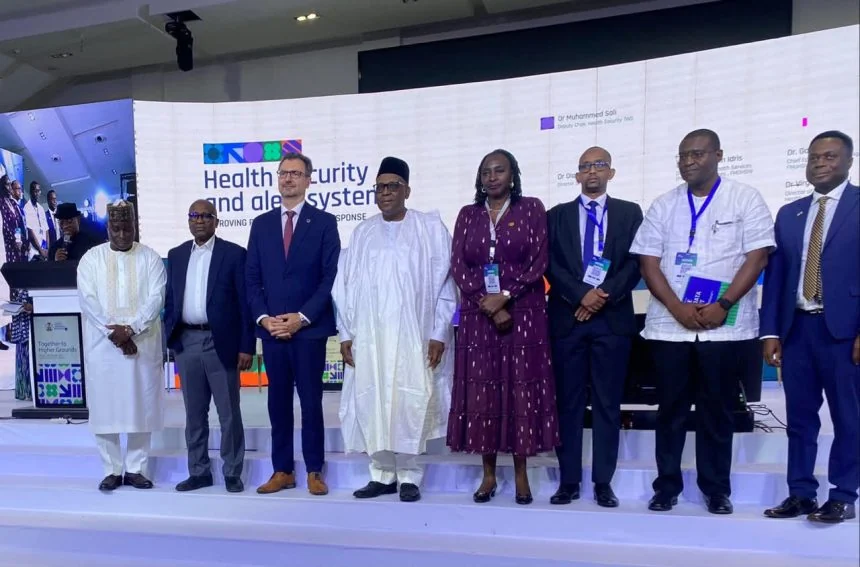
ABUJA, NIGERIA — Nigeria’s Lassa fever season began early in November, with infections among health workers, officials said in an NCDC health security update presented at the close of the 2026 Health Sector Joint Annual Review, Tribune Online reported.
Muhammad Sali, Deputy Chair of the Health Security Technical Working Group, said Nigeria has no active Ebola case after handling an imported infection, but contacts in Nigeria and Switzerland remain under monitoring. He also cited the dengue outbreak in Zamfara State, with about 366 cases and 46 deaths, and called for year-round preparedness ahead of the 2027 outbreak season.
What the NCDC health security update showed
Nigeria Centre for Disease Control and Prevention (NCDC) Director-General Dr Jide Idris said rapid response teams have been trained in all 36 states and the Federal Capital Territory, and 25 laboratories in 20 states are connected through laboratory information management systems, according to Tribune.
The agency’s early warning system had detected 148 signals as of October 2026. In October alone it received 3,728 calls, reviewed 913 media articles and escalated 34 signals. Response teams reached more than 77,000 people in the FCT between 28 October and 6 November, Idris said.
The FCT outreach followed Nigeria’s imported Ebola case in Abuja in October, when contact tracing and community sensitisation were stepped up. The NCDC said this week that no new Ebola case had been recorded in 21 days, though contacts were still being monitored.
Event-based surveillance, which monitors calls, media reports and community information for unusual health events, complements reports from health facilities and can pick up outbreaks earlier.
The NCDC health security update also highlighted the role of laboratory networks. Connecting laboratories electronically allows results to reach surveillance teams faster, reducing the time between a sample being taken and a response being organised.
Lassa fever and health workers
Lassa fever is a viral haemorrhagic illness spread mainly through contact with food or household items contaminated by the urine or faeces of infected Mastomys rats. It can also spread from person to person through contact with blood and body fluids, which puts health workers at risk when infection prevention measures are weak or the disease is not suspected.
Early symptoms, including fever, weakness, headache and sore throat, resemble malaria and other common illnesses. Severe cases can cause bleeding, breathing difficulty, shock and kidney failure. The antiviral ribavirin is most effective when started early.
Health worker infections are a recurring feature of Lassa outbreaks in Nigeria. In past seasons, doctors, nurses and laboratory staff have died after caring for patients before Lassa fever was suspected, prompting calls for better protective equipment, isolation wards and hazard allowances.
Nigeria recorded more than 1,100 confirmed Lassa fever cases and more than 260 deaths by October 2026, according to NCDC reports cited by Nigerian media, and the peak season usually runs from December to April.
Protecting health workers and communities
Health workers should use standard precautions with every patient, including gloves and hand hygiene, and full protective equipment when Lassa fever is suspected. Testing patients with fever who do not respond to malaria treatment can help detect cases earlier.
Households can reduce risk by storing food in rodent-proof containers, keeping homes clean, disposing of rubbish properly and avoiding drying food in the open where rats can reach it.
Community awareness is particularly important in states that usually report the most cases, such as Ondo, Edo, Bauchi, Taraba and Ebonyi, where Lassa fever is endemic.
People who develop fever after contact with a suspected Lassa patient, or after exposure to rodents, should seek care early and tell health workers about the exposure. Early treatment with ribavirin significantly improves survival, while late presentation is a major cause of death.
Funding remains a constraint. The NCDC has said its N10 billion emergency fund covers Ebola, Lassa fever and other emerging diseases, and lawmakers have questioned whether states are investing enough in preparedness.
The NCDC has also warned of rising meningitis risk as the dry season advances and continuing diphtheria among unvaccinated children, and urged event organisers to prepare for festive-season gatherings.
The NCDC health security update comes as the Joint Annual Review highlighted that only 22 per cent of public health events met the seven-day early response target during the review period, according to Permanent Secretary Daju Kachollom. Officials said improving response speed, funding and laboratory networks will be central to preparedness for 2027.
The next NCDC health security update is expected as Lassa fever cases begin to rise towards the usual peak between December and April, when weekly situation reports track confirmed cases, deaths and affected states.
Why it matters: An early Lassa season with health worker infections means clinics must strengthen infection control before the December peak.
Zamfara Confirms Dengue Fever Outbreak as Deaths Rise to 46 GUSAU, NIGERIA — The Zamfara State Government has confirmed that a Zamfara dengue fever outbreak caused an illness that has killed 46 people in Shinkafi, Moriki and nearby communities, with 366 suspected cases recorded, AIT reported…
Lassa Fever Warning Signs: Early Action Saves Lives Lassa fever is a viral illness that is found in West Africa, and Nigeria reports more cases than any other country. Each year, outbreaks peak during the dry season, from about December to April. In…
Nigeria Marks 21 Days Without New Ebola Case as… ABUJA, NIGERIA — Nigeria has recorded no further confirmed Ebola case in the 21 days since it confirmed an imported Bundibugyo virus infection, the Nigeria Centre for Disease Control and Prevention (NCDC) said in a Nigeria…
NCDC Expects to Finish Monitoring 62 Ebola Contacts… ABUJA, NIGERIA — Nigeria Ebola contact monitoring is expected to end by 13 November, when the last of 62 people exposed to the country’s only confirmed case complete their follow-up period, the Nigeria Centre for…