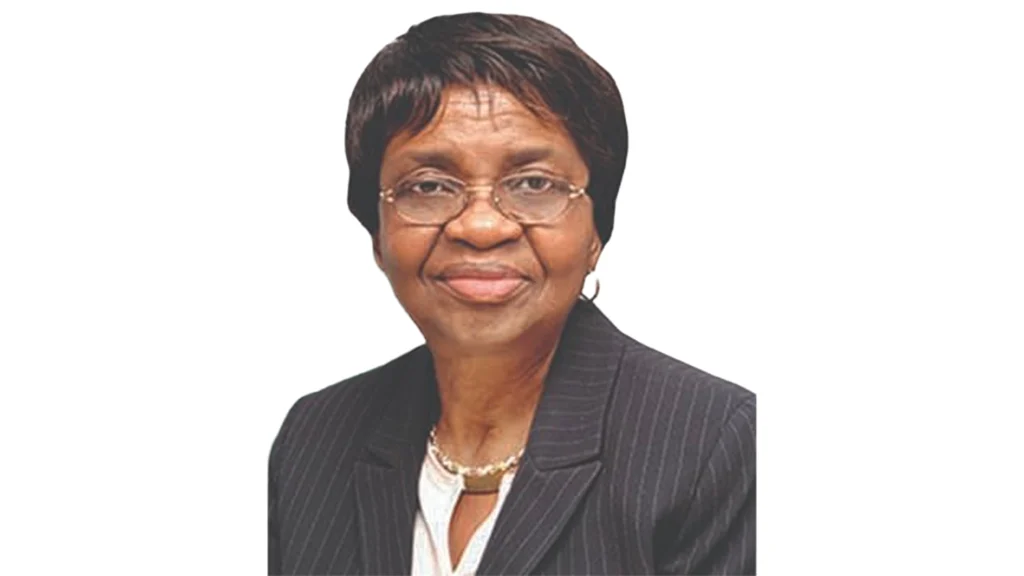
When Professor Mojisola Adeyeye walked into NAFDAC headquarters in November 2017, she inherited an agency with a debt of more than three billion naira, laboratories that did not work and a reputation that its own staff joked about. Nine years later, the Professor Mojisola Adeyeye NAFDAC era has become shorthand across African regulatory circles for what a determined reformer can do with a broken institution. This profile traces the career that prepared her for the job, the decisions that defined her tenure and what remains unfinished.
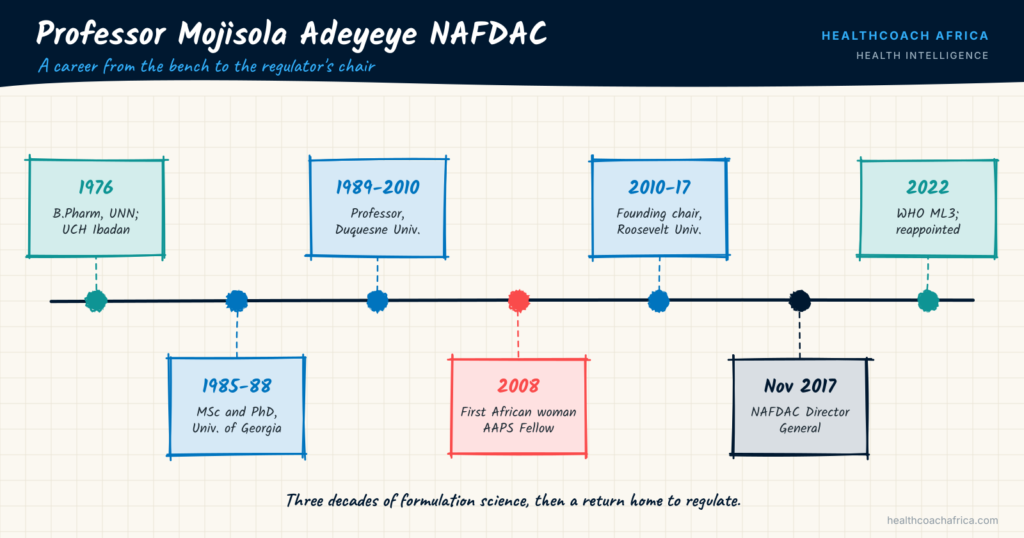
Career timeline of the Professor Mojisola Adeyeye NAFDAC story, from UNN pharmacy graduate to Director General
From Nsukka to the laboratory bench
Mojisola Christianah Adeyeye graduated in pharmacy from the University of Nigeria, Nsukka, in 1976. She began her career where many Nigerian pharmacists do, in hospital practice, working at University College Hospital, Ibadan, from 1976 to 1979, and then at the Baptist Hospital in Ogbomoso.
In the early 1980s she moved to the United States for graduate study at the University of Georgia, earning a master’s degree in 1985 and a PhD in pharmaceutics in 1988. That training in how medicines are formulated, manufactured and tested would shape everything that followed.
Three decades in American pharmacy science
Her academic career began in 1988 at the University of Puerto Rico’s School of Pharmacy. A year later she joined Duquesne University in Pittsburgh, where she spent 21 years rising from assistant professor to full professor of pharmaceutics and manufacturing science.
In 2010 she moved to Roosevelt University in Illinois as a founding professor of its new College of Pharmacy and founding chair of the Department of Biopharmaceutical Sciences. She is now Professor Emeritus there.
Her research focused on early drug development: preformulation, the characterisation of excipients and the design of solid, semi-solid and liquid dosage forms. Much of it was aimed at a gap she cared about deeply, the lack of suitable medicines for children in poor countries. Through Duquesne she developed a paediatric fixed-dose combination of antiretroviral drugs for children with HIV, with intellectual property secured in the UK and South Africa. She co-invented five drug patents, mentored more than 15 PhD and master’s candidates and published widely.
Recognition followed. In 2008 she became the first African woman elected a Fellow of the American Association of Pharmaceutical Scientists, an honour given to a very small share of its members. She is a Senior Fulbright Scholar and Specialist, a Fellow of the Nigeria Academy of Pharmacy and, since 2016, a Fellow of the Nigerian Academy of Science. When she was inducted, she was only the eighth pharmacist, and the third woman pharmacist, to receive that honour.
Service beyond the lab
Alongside her academic work, she built organisations rooted in her concern for children and people living with HIV. She founded Drugs for AIDS and HIV Patients, a non-profit working on prevention, education, care and treatment for children with HIV in Nigeria, and Sarah Extended Family Homes for Children to support children affected by HIV from kindergarten to university. She also founded Elim Pediatric Pharmaceuticals, a start-up aimed at developing child-friendly medicines.
The Professor Mojisola Adeyeye NAFDAC era begins
Professor Adeyeye was appointed Director General of the National Agency for Food and Drug Administration and Control on 3 November 2017. In December 2022 she was reappointed for a second and final five-year term.
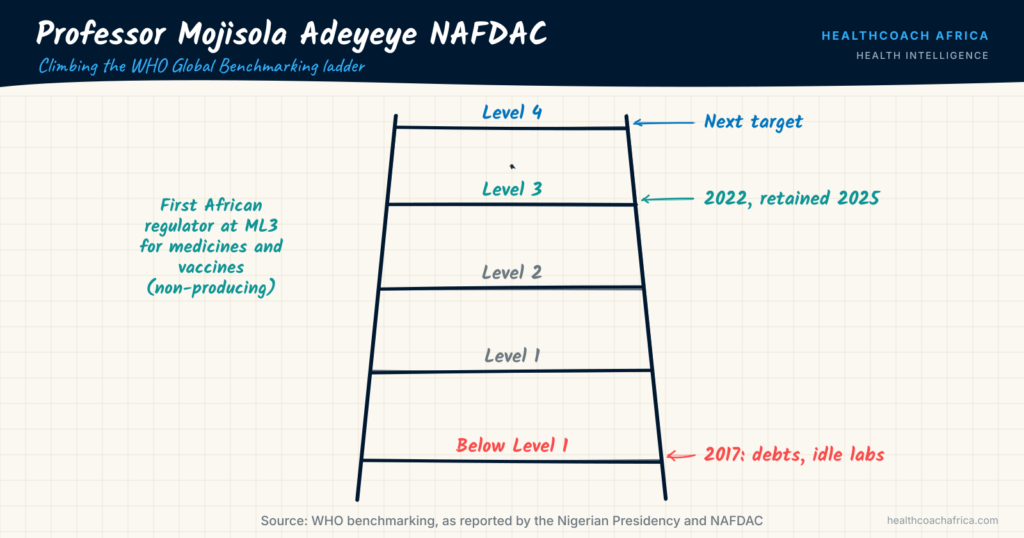
The agency she found was in poor shape. By her own account and later reporting, NAFDAC carried debts of over 3.2 billion naira, had non-functional laboratories and no inspection vehicles, and was rated below the first rung of the WHO Global Benchmarking Tool.
Her approach combined financial discipline with a culture change. She cut costs, including official travel, to clear inherited liabilities. She pushed the agency toward written standard operating procedures, international quality standards and a customer-focused mindset. She invested in laboratories, digitised product registration and strengthened inspection.
WHO maturity ladder of the Professor Mojisola Adeyeye NAFDAC reforms, from below Level 1 to Level 3
NAFDAC’s climb on the WHO Global Benchmarking ladder since 2017, with Level 4 as the stated next goal.
The results became measurable. In 2022 NAFDAC attained WHO Maturity Level 3 for the regulation of medicines and vaccines (non-producing), becoming the first national regulatory authority in Africa to reach that level in this category. After a re-benchmarking exercise in 2025, the WHO confirmed that the agency had retained that status. Speaking at Harvard’s T.H. Chan School of Public Health in late 2026, she named Maturity Level 4 and WHO-Listed Authority status as the agency’s next targets.
Her signature reforms
Several initiatives stand out:
Local manufacturing. Under her leadership NAFDAC introduced the “5 plus 5” scheme, encouraging companies that import finished medicines to transition toward local production, and has publicly supported the federal government’s pharmaceutical executive order.
Traceability. She championed GS1-based pharmaceutical traceability, from vaccine tracking pilots to the Pharmaceutical Products (Traceability) Regulations gazetted in 2024.
A modern rulebook. NAFDAC has gazetted more than thirty regulations on food, drugs and chemicals since 2021.
Continental leadership. She has chaired the steering committee of the African Medicines Regulatory Harmonization programme and represents NAFDAC on the International Coalition of Medicines Regulatory Authorities.
Public protection. The agency has pursued high-profile enforcement, from seizures of falsified medicines to the ban on alcohol sold in sachets and small bottles.
Her tenure has not been free of controversy. She has spoken publicly about internal and external pressure for her removal, and some enforcement actions have drawn pushback from industry. That friction is perhaps unavoidable for a regulator who chose to enforce rather than accommodate.
In July 2026 she received the Special African Leadership Commendation Award at the African Business Leadership Awards, held at the UK House of Lords, recognising her contribution to regulatory science and pharmaceutical governance.
Why she is a trailblazer
By the standards this series uses, the Professor Mojisola Adeyeye NAFDAC turnaround meets every test. She built an institution that should outlast her. She opened doors as one of the first African women to reach the top of global pharmaceutical science. She has mentored a generation of scientists and regulators. And she chose public service in Nigeria after a long and comfortable career abroad, at a time when the flow of professionals runs firmly the other way.
For young pharmacists, her career is a map worth studying: hospital practice, deep scientific training, decades of research and teaching, then the decision to bring that expertise home and apply it at national scale.
Lessons for young pharmacists
Her path offers three practical lessons for pharmacists early in their careers.
First, depth compounds. Her authority as a regulator rests on decades of formulation science; she could challenge a manufacturer’s dossier because she had written dossiers herself.
Second, practice informs policy. Her years in hospital pharmacy at Ibadan and Ogbomoso gave her a ground-level view of what happens when medicines fail patients, a view she carried into regulation.
Third, institutions are built by systems, not heroes. Her most lasting work at NAFDAC is not any single raid or ban but the procedures, laboratories, regulations and quality standards that will keep working after she leaves office.
From the HubPharm pharmacy desk. Professor Adeyeye’s message has been consistent for nine years: buy medicines only from licensed, regulated sources. Every product HubPharm dispenses carries a NAFDAC registration number and comes through verified supply. If you are unsure whether a medicine you were sold is genuine, send the code HC-TR01 with a photo of the pack on WhatsApp to +234 705 050 5001 and a HubPharm pharmacist will help you check it.
This profile is compiled from public records, published interviews and official NAFDAC statements. Titles and roles are as reported at the time of publication. To correct or update any detail, contact HealthCoach Africa.
eNews Park Forest (Roosevelt University). Roosevelt University pharmacy professor elected as Nigerian Academy of Science Fellow. 27 June 2016. https://enewspf.com/?p=128002
NAFDAC. Address by Prof. Mojisola Christianah Adeyeye at the 49th Annual International Conference of the Chemical Society of Nigeria. 15 September 2026.
Please follow and like us:
Views:36
Related Posts:
African Medicines Agency Opens Two Regulatory Hubs in Kigali KIGALI, RWANDA — The African Medicines Agency (AMA) has launched two hubs in Kigali to help African countries make faster decisions on medicines and support local manufacturers, during its inaugural AMA Week. The African Medicines…
Medicine Traceability in Nigeria: How a Barcode… A fake antimalarial looks exactly like a real one. The box, the blister and the colour of the tablet can all be copied. What cannot be copied easily is a unique digital identity that is…
NCDC Says Nigeria Needs N104bn a Year for Health… ABUJA, NIGERIA — The Nigeria health security plan for 2025 to 2029 will cost about N522 billion, or an average of N104.4 billion a year, the Nigeria Centre for Disease Control and Prevention (NCDC) told…
Signs of Postpartum Depression Every New Mother Should Know A new baby is expected to bring joy, so many mothers hide how they really feel. Yet studies in Nigeria have found depression in anywhere from about 15% to 45% of women after childbirth, depending…