Many Nigerians live with indigestion for years. They buy antacids, try herbal mixtures and call every pain an “ulcer”. Most of the time, the cause is simple. But stomach cancer warning signs can look exactly like ordinary indigestion at first. Because the early signs are mild, many people reach a doctor only when the cancer has spread. This guide explains what to watch for, who is at higher risk, how stomach cancer is found and why acting early matters.
What is stomach cancer?
Stomach cancer, also called gastric cancer, starts in the cells lining the stomach. It usually grows slowly over many years. Before cancer forms, the lining often goes through changes, such as long-term inflammation and thinning. These changes do not cause cancer on their own, but they raise the risk.
Most stomach cancers are adenocarcinomas, which begin in the gland cells of the lining. Less common types include lymphoma of the stomach and gastrointestinal stromal tumours. Each type is treated differently, which is why a proper diagnosis matters.
The main stomach cancer warning signs
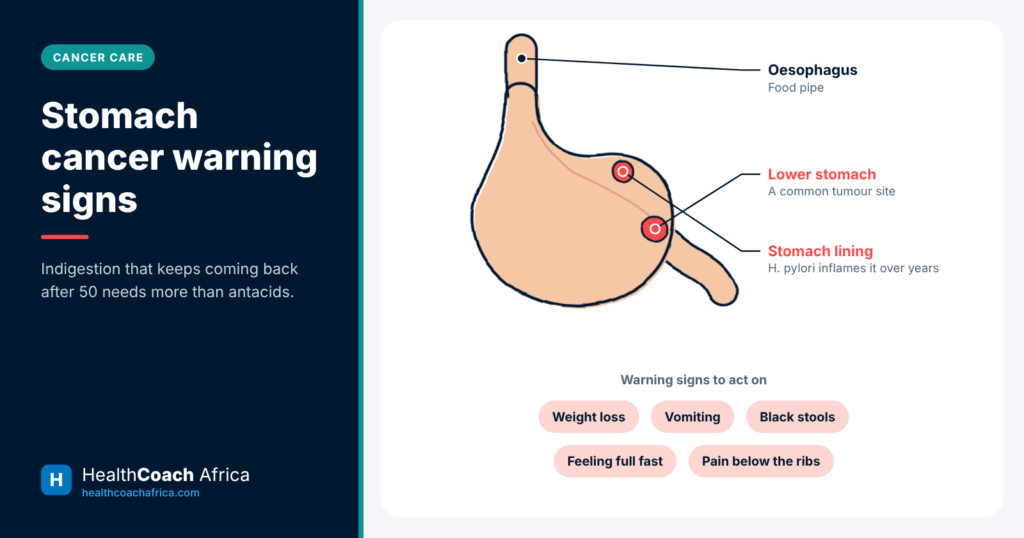
Early stomach cancer often causes no symptoms at all. When symptoms appear, they are usually vague. Watch for these stomach cancer warning signs, especially if they last for three weeks or more:
Indigestion or heartburn that keeps coming back, particularly if it is new after the age of 50
Feeling full quickly, even after a small meal
Pain or discomfort in the upper belly, often just below the breastbone
Loss of appetite, sometimes with a new dislike of meat
Unexplained weight loss
Nausea or vomiting, sometimes with blood
Black, tarry stools, a sign of bleeding in the stomach
Tiredness and breathlessness, caused by anaemia from slow bleeding
Difficulty swallowing, if the cancer is near the top of the stomach
A lump in the upper belly in later stages
None of these symptoms proves you have cancer. Ulcers, gastritis and gallstones cause many of the same problems. However, symptoms that persist, return quickly after treatment or come with weight loss always deserve a doctor’s review.
Red flag symptoms that need urgent care
Some symptoms need same-day medical attention. Go to a hospital immediately if you:
Vomit blood or material that looks like coffee grounds
Pass black, sticky stools
Feel faint, dizzy or very weak
Have severe belly pain that will not settle
Cannot keep food or fluids down
These signs may point to bleeding or a blockage. Both can be life-threatening, whatever the cause.
Who is at higher risk?
Anyone can develop stomach cancer, but the risk is higher if you:
Are over 50 years old
Are male, since men are affected more often than women
Have long-term infection with Helicobacter pylori (H. pylori), a common stomach bacterium
Eat a lot of salted, smoked or preserved foods
Smoke tobacco
Drink alcohol heavily
Have a close relative who had stomach cancer
Have had stomach surgery in the past
Have pernicious anaemia, a condition linked to long-term stomach inflammation
pylori deserves special attention. It is common in Nigeria and many other countries. Most people with it never develop cancer. Still, long-term infection inflames the stomach lining and is a major risk factor for stomach cancer.
HUBPHARM PHARMACIST’S NOTE
If you have needed antacids or acid-reducing tablets for more than a few weeks, that is worth a conversation. Long-term self-treatment can hide symptoms that need an endoscopy. Send a photo of the indigestion medicines you use to a HubPharm pharmacist. We will check how long you have been taking them, flag anything that irritates the stomach, such as anti-inflammatory painkillers, and tell you when it is time to see a doctor. If you are prescribed H. pylori treatment, we can also deliver the full course and send reminders, so that you finish every dose.
Why stomach cancer is often found late
Stomach cancer is often diagnosed late in Nigeria and across Africa. Several factors contribute. Early symptoms are mild and easy to ignore. Many people treat themselves with antacids or herbal remedies for months. Some fear that tests will be expensive or painful. In addition, endoscopy services are not available in every town.
Self-treatment can hide stomach cancer warning signs. Antacids and acid-reducing tablets1 may ease symptoms for a while, even when cancer is present. If you need indigestion medicine for more than a few weeks, ask a doctor whether you need further tests.
How stomach cancer is diagnosed
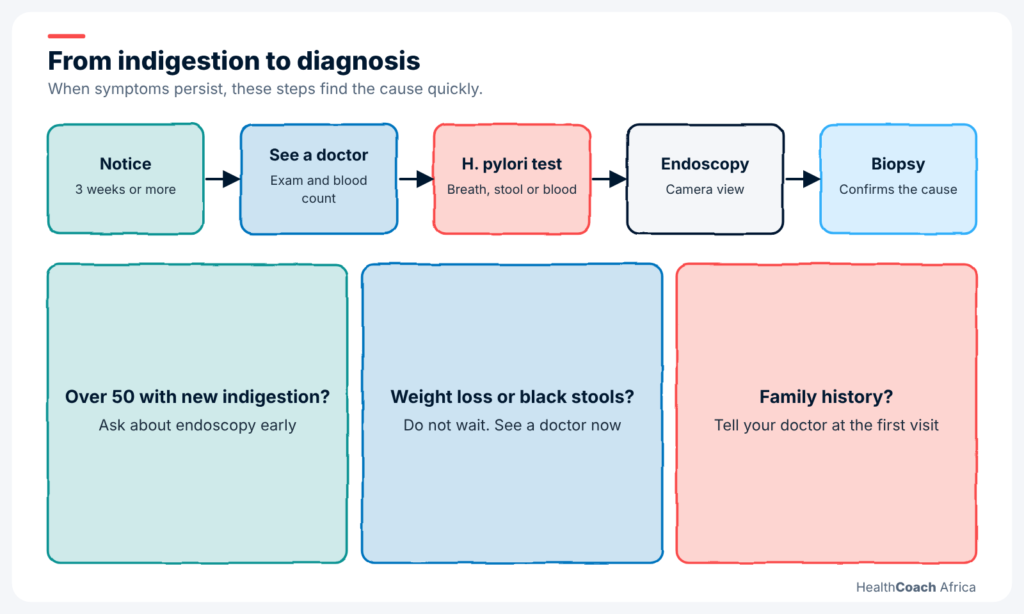
Flow chart from persistent indigestion to endoscopy and biopsy, for people with stomach cancer warning signs
Do not rely on antacids for months. Persistent symptoms need proper tests.
If your doctor suspects a problem, they will ask about your symptoms and examine your belly. The main tests include:
Blood tests to check for anaemia and to assess your general health.
H. pylori testing, using a breath test, stool test or blood test.
Upper endoscopy (gastroscopy), where a thin, flexible camera is passed through the mouth into the stomach. This is the key test.
Biopsy, where small samples of tissue are taken during endoscopy and examined in a laboratory.
Scans, such as a CT scan, to see whether cancer has spread if it is confirmed.
Endoscopy is usually done under light sedation or with a throat spray. It takes about 15 minutes. You will need to stop eating for several hours beforehand.
Treatment options
Treatment depends on the type of cancer, how far it has spread and your general health. The main options are:
Surgery to remove part or all of the stomach. This offers the best chance of cure when the cancer is found early.
Chemotherapy, often given before and after surgery to shrink the tumour and reduce the chance of it returning.
Radiotherapy, used in some cases alongside chemotherapy.
Targeted therapy and immunotherapy for some advanced cancers.
Palliative care to control pain, improve eating and maintain quality of life when cure is not possible.
People who have part or all of their stomach removed need to adjust how they eat. Small, frequent meals work best. Many also need vitamin B12 injections2 for life, because the stomach normally helps the body absorb this vitamin.
Lowering your risk
You cannot control every risk factor, but you can reduce your risk:
Get tested and treated for H. pylori if you have long-term indigestion or a family history of stomach cancer
Eat plenty of fresh fruit and vegetables
Cut down on salted fish, smoked meat and heavily preserved foods
Store food safely, ideally in a fridge, rather than relying on salting and smoking
Stop smoking
Limit alcohol
Keep a healthy weight
Treating H. pylori3 takes a combination of antibiotics and an acid-reducing medicine, usually for one to two weeks. Completing the full course is essential. Afterwards, a repeat test confirms that the infection has cleared.
Myths about stomach pain
“All stomach pain is an ulcer.” Many conditions cause stomach pain. Persistent symptoms need proper tests.
“If antacids help, it cannot be cancer.” Antacids can ease symptoms even when cancer is present.
“Endoscopy is dangerous.” It is a common, safe test performed in many Nigerian hospitals.
“Stomach cancer only affects old people.” It is more common after 50, but younger adults can be affected.
Questions to ask your doctor
Could my symptoms be one of the stomach cancer warning signs?
Should I be tested for H. pylori?
Do I need an endoscopy, and where can I have it done?
How long should I take my indigestion medicine before we review it?
Are any of my other medicines irritating my stomach?
Write down your symptoms, when they started and anything that makes them better or worse. Bring this list to your appointment.
Supporting a family member
If a relative has stomach cancer warning signs but keeps putting off a check, offer practical help. Go with them to the appointment, help with transport costs or look after their children for the day. Fear of bad news stops many people from seeking care. Gentle encouragement from someone they trust can make the difference between an early and a late diagnosis.
Getting help
If you have indigestion that lasts more than three weeks, weight loss or any of the stomach cancer warning signs above, book an appointment with a doctor. The NHS guide to stomach cancer has more detail, and our cancer care articles cover related topics.For help with H. pylori treatment, indigestion medicines or questions about your symptoms, message a HubPharm pharmacist or chat with Afiya on WhatsApp.
Medicines and products in this article
#
Medicine or product
What to know
1
Antacids and acid-reducing tablets
Over the counter or prescription
Ease indigestion for a short time. Need review if used for more than a few weeks.
2
Vitamin B12 injections
Prescription only
Needed for life after the stomach is removed.
3
H. pylori eradication therapy
Prescription only
Two antibiotics plus an acid-reducing medicine for one to two weeks. Finish every dose.
To order any of these, or to ask a pharmacist a question first, message HubPharm on WhatsApp or visit hubpharmafrica.com. Prescription medicines are supplied against a valid prescription.
Chemotherapy Side Effects Guide: How to Cope at Home Starting chemotherapy can feel frightening. Many people have heard stories of severe sickness and hair loss. In reality, side effects vary widely. Some people have very few, while others need extra support. This chemotherapy side…
Period Pain Relief Tips for Every Woman and Girl Most women and girls experience some pain during their periods. For many, it is a mild ache. For others, it is severe enough to cause vomiting, fainting or days off school and work. Too often,…
Chronic Pain Management in African Women: A… Chronic pain, characterized by persistent discomfort lasting for more than three to six months, is a global health challenge that affects millions of individuals. In the context of Africa, chronic pain poses unique considerations, and…
Lower Back Pain Relief: What Works and When to Worry Low back pain is the leading cause of disability worldwide. The World Health Organization estimates that it affected 619 million people in 2020, and almost everyone experiences it at least once. Market traders, drivers, office…