The thyroid is a small gland in the neck, but during pregnancy it carries a heavy load. For the first three months, a baby depends entirely on the mother’s thyroid hormone for brain development. Thyroid disease in pregnancy is one of the most common hormone problems expectant mothers face, yet it is often missed because the symptoms resemble pregnancy itself. With testing and correct treatment, most women have healthy pregnancies and healthy babies.
How pregnancy changes the thyroid
Pregnancy hormones push the thyroid to make up to 50% more hormone than usual. The gland may enlarge slightly, and the body’s need for iodine rises. A healthy thyroid copes with this demand. However, one that is already under strain may not. That is when thyroid disease in pregnancy appears or worsens.
Planning a pregnancy when you have a thyroid condition
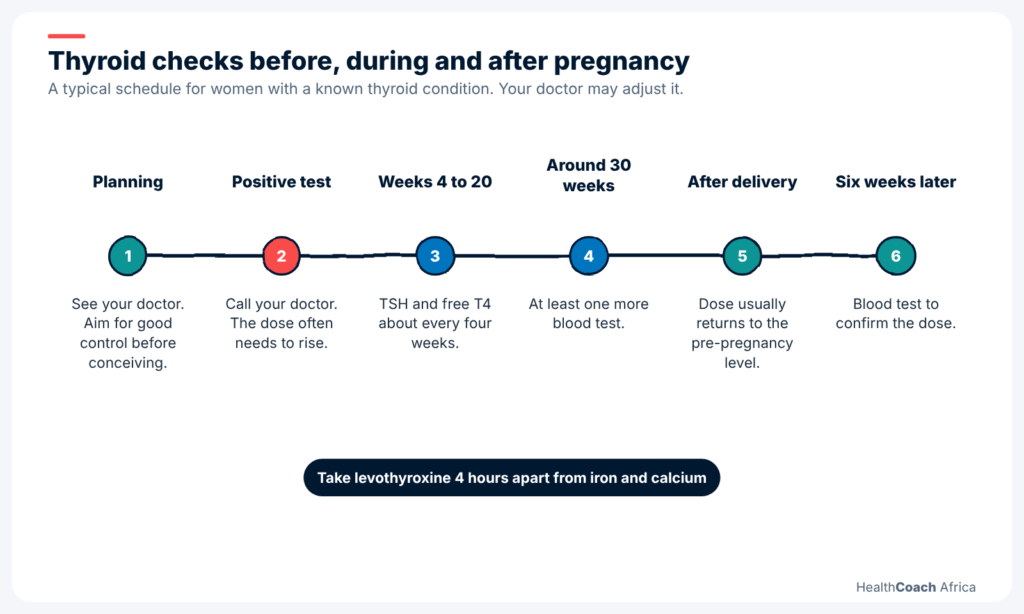
The best time to deal with thyroid disease in pregnancy is before you conceive. If you already have a thyroid condition, see your doctor as soon as you start planning a baby.
For women on levothyroxine, doctors usually aim for a TSH in the lower half of the normal range before conception. For women with an overactive thyroid, the goal is stable control first, followed by a discussion about which medicine is safest in early pregnancy. After radioactive iodine treatment, you should wait at least six months before trying to conceive.
In addition, start folic acid, as every woman planning a pregnancy should. Untreated thyroid problems can make it harder to conceive, so good control improves fertility as well.
Is it pregnancy or the thyroid?
Pregnancy and thyroid disease share many symptoms. Tiredness, constipation, weight change, palpitations and feeling hot are common in both. As a result, thyroid problems are easily overlooked.
Certain clues point towards the thyroid:
A visible swelling in the front of the neck
Shaky hands or a resting pulse above 100
Losing weight in spite of a good appetite
Feeling cold when others are comfortable
A strong family history of thyroid disease
None of these proves anything. However, a blood test settles the question quickly and cheaply.
An underactive thyroid (hypothyroidism)
Common causes include an autoimmune condition called Hashimoto’s disease, iodine deficiency and previous thyroid surgery. Symptoms include tiredness, feeling cold, constipation, dry skin, a slow pulse and low mood.
If left untreated, an underactive thyroid raises the risk of miscarriage, anaemia, pre-eclampsia, premature birth and low birth weight. It may also affect the baby’s brain development.
The treatment is levothyroxine, which is safe in pregnancy and during breastfeeding. If you already take it, your dose usually needs to rise by a quarter to a half. Therefore, contact your doctor as soon as you have a positive pregnancy test. Do not wait for your first antenatal visit, and never stop the tablets.
An overactive thyroid (hyperthyroidism)
The usual cause is Graves’ disease. Symptoms include a racing heart, weight loss, shaky hands, heat intolerance, anxiety and a swelling in the neck. Without control, it can lead to miscarriage, premature birth, pre-eclampsia and heart strain in the mother.
Doctors treat it with antithyroid tablets at the lowest effective dose. They often prefer propylthiouracil in the first three months and may switch to carbimazole later. Radioactive iodine is never used in pregnancy.
In addition, severe vomiting in early pregnancy can cause a mild, temporary overactivity. This usually settles on its own by the middle of pregnancy.
Tests and monitoring for thyroid disease in pregnancy
A blood test for TSH and free T4 is all that is needed. Ask for one early if you have:
Known thyroid disease or previous thyroid surgery
A goitre or a family history of thyroid problems
Type 1 diabetes or another autoimmune condition
A history of miscarriage, premature birth or infertility
Symptoms that suggest a thyroid problem
Women on treatment should be tested about every four weeks until the middle of pregnancy, and at least once more near 30 weeks. Pregnancy has its own normal ranges, so your doctor will interpret the results.
Iodine in the Nigerian diet
The thyroid needs iodine to make hormone, and the requirement rises in pregnancy and during breastfeeding. Too little iodine can cause goitre in the mother and can affect the baby’s brain development.
Good sources include:
Iodised salt, which is the main source for most households
Sea fish and other seafood
Eggs and milk
Check that the salt packet carries a NAFDAC number, and store it in a closed container, since iodine is lost when salt is left open. Advice to eat less salt still applies. Simply make sure that the small amount you use is iodised. On the other hand, too much iodine is also harmful, so avoid high-dose supplements unless they are prescribed.
Five practical rules
Take levothyroxine on an empty stomach. Swallow it with water at the same time each day, 30 to 60 minutes before food.
Separate it from supplements. Iron, calcium and antacids block absorption. Because pregnancy vitamins contain iron and calcium, leave a gap of at least four hours.
Use iodised salt. However, avoid kelp, seaweed and high-dose iodine supplements unless your doctor recommends them.
Avoid herbal remedies for goitre. None has been shown to be safe in pregnancy.
Keep every blood test appointment. Doses often change more than once.
How thyroid disease can affect the baby
When the mother is well treated, the baby is almost always healthy. Problems arise mainly when thyroid disease in pregnancy goes unrecognised.
In Graves’ disease, the antibodies that overstimulate the mother’s thyroid can cross the placenta. For that reason, the baby’s heart rate and growth are watched closely. After birth, the newborn is examined and may have a blood test.
Babies can also be born with an underactive thyroid for reasons unrelated to the mother. Where newborn screening is available, a heel-prick test detects this in the first week. Treatment started early allows completely normal development.
Goitre and nodules found during pregnancy
A lump in the neck sometimes appears for the first time in pregnancy. Most are harmless. An ultrasound scan is safe at any stage, and a needle test can be done if the doctor needs a sample. Scans that use radioactive material are avoided until after delivery and breastfeeding. If an operation is needed, it is usually planned for the middle months of pregnancy or after the birth.
After delivery
Your levothyroxine dose usually returns to its pre-pregnancy level, with a blood test about six weeks later. Breastfeeding is safe on levothyroxine and on low doses of antithyroid medicine.
Furthermore, about one in twenty women develop thyroid inflammation in the year after birth. It can cause anxiety and palpitations at first, then exhaustion and low mood. Because it is easily mistaken for postnatal depression, ask for a thyroid test if you do not feel like yourself.
Frequently asked questions
Is levothyroxine safe for my baby?
Yes. It is identical to the hormone your own thyroid makes. Not taking it is what puts the baby at risk.
Will my baby inherit my thyroid condition?
Most babies do not. Thyroid problems do run in families, though, so mention your history to your child’s doctor.
What if I miss a dose?
Take it when you remember on the same day. If you miss several doses, do not try to catch up all at once. Ask your pharmacist or doctor.
Can I breastfeed on thyroid medicine?
Yes. Levothyroxine is safe, and antithyroid medicines are safe at the doses doctors normally use.
How often will I need blood tests?
With thyroid disease in pregnancy, expect a test about every four weeks in the first half of pregnancy, at least once later on and again about six weeks after delivery.
The essentials
Thyroid disease in pregnancy is common, and it is very manageable. Tell your doctor early, take your tablets correctly, keep your blood test dates and use iodised salt. Those four steps protect both you and your baby.
Getting help
Managing thyroid disease in pregnancy takes teamwork between you, your doctor and your pharmacist. HubPharm pharmacists can help you time your tablets around supplements and keep your refills on schedule. For more detail, read our guide to hypothyroidism or the US National Institutes of Health page on thyroid disease & pregnancy.
Please follow and like us:
Views:112
Related Posts:
Signs of Postpartum Depression Every New Mother Should Know A new baby is expected to bring joy, so many mothers hide how they really feel. Yet studies in Nigeria have found depression in anywhere from about 15% to 45% of women after childbirth, depending…
Malaria Prevention in Pregnancy: Protecting Mother and Baby Pregnancy changes the body's defences, and malaria takes advantage of this. In Nigeria, where malaria is present all year round, pregnant women face a higher risk of infection and of serious complications. Fortunately, simple and…
Thyroid Function Test Results: What TSH, T3 and T4… You have collected your laboratory report, and it is full of abbreviations, numbers and arrows. Thyroid function test results are among the most commonly requested blood tests, and also among the most misunderstood. This guide…
Hepatitis B in Nigeria: Testing, Vaccine and… Hepatitis B is a viral infection that attacks the liver, often silently, for decades. The World Health Organization's 2026 Global Hepatitis Report lists Nigeria among ten countries that together account for nearly 70% of deaths…