Finding a lump in your neck can be frightening. Many people immediately fear cancer. In fact, thyroid nodules are very common, and most of them are harmless. Only a small minority turn out to be cancer, and most thyroid cancers can be treated successfully. This guide explains thyroid nodules and cancer, how doctors decide which lumps need testing and what treatment involves.
What a thyroid nodule is
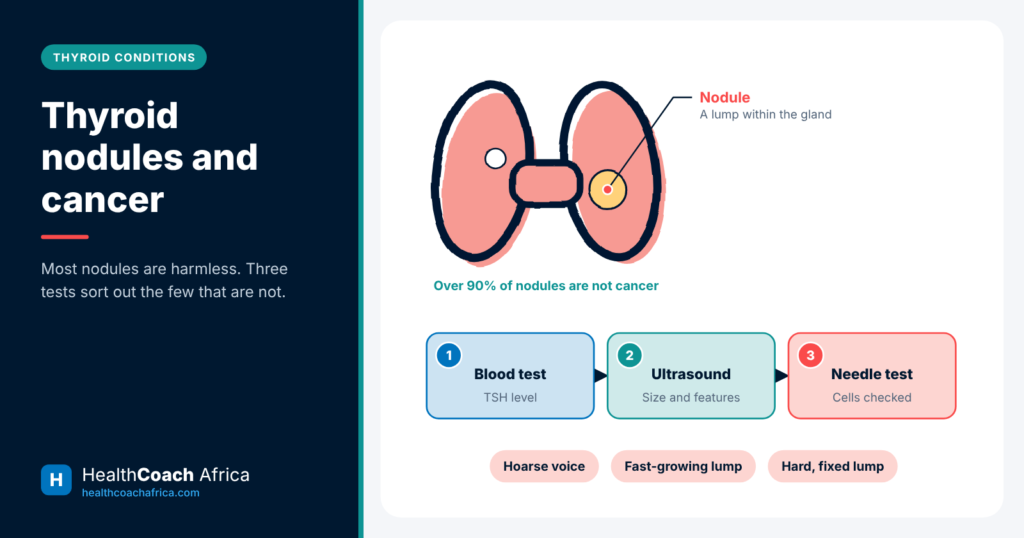
A thyroid nodule is a lump that forms within the thyroid gland, which sits at the front of the neck below the Adam’s apple. Nodules can be solid or filled with fluid. Some people have one nodule, while others have several. Many nodules are found by chance during a scan for another reason.
Benign growths of normal thyroid tissue, sometimes linked to iodine deficiency
Thyroid cysts, which are fluid-filled
Inflammation of the thyroid, such as Hashimoto’s thyroiditis
Multinodular goitre, where the gland contains many nodules
Overactive nodules, which make extra thyroid hormone
Thyroid cancer, in a small number of cases
Symptoms
Most nodules cause no symptoms. When they do, you may notice:
A lump in the front of the neck that moves when you swallow
A feeling of pressure or fullness in the throat
Difficulty swallowing or breathing if the nodule is large
A hoarse voice
Symptoms of an overactive thyroid, such as weight loss and a racing heart, if the nodule makes hormone
Warning signs that need prompt review
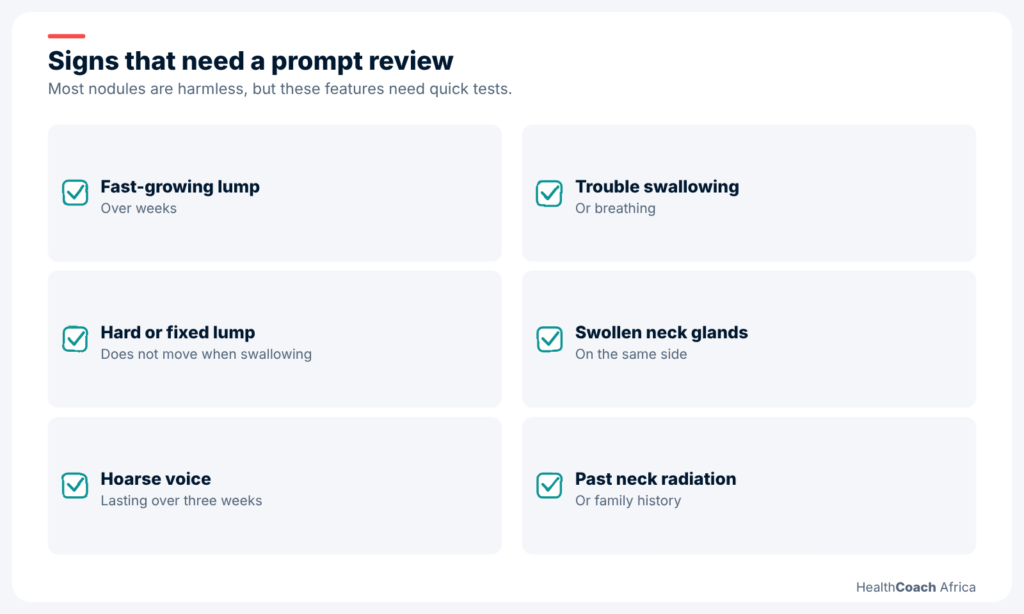
See a doctor soon if a neck lump:
Grows quickly over weeks
Is hard and fixed
Comes with swollen glands in the neck
Comes with a hoarse voice that does not improve
Causes difficulty breathing or swallowing
You should also mention a history of radiation to the head or neck in childhood, or a family history of thyroid cancer.
Warning signs in thyroid nodules and cancer that need prompt review
Tell your doctor about any of these, especially if the lump is new.
Thyroid nodules and cancer: who is at higher risk?
Most people with nodules have no special risk factors. However, the chance that a nodule is cancer is higher in:
People who had radiation to the head, neck or chest in childhood
People with a parent, brother or sister who had thyroid cancer
Men, because nodules are less common in men but more likely to be cancer
Children and teenagers with a nodule
Adults over 60
People whose nodule is growing quickly
Tell your doctor about any of these. They help guide decisions about thyroid nodules and cancer testing.
Step 1: blood tests
The first test is usually a thyroid function test, measuring TSH. If TSH is low, the nodule may be overactive. Overactive nodules are rarely cancer, and a special scan may be done next. If TSH is normal or high, an ultrasound is the next step.
Step 2: ultrasound scan
An ultrasound shows the size, shape and features of each nodule. Some features suggest a higher risk of cancer, such as being very dark on the scan, having irregular edges, containing tiny bright spots called microcalcifications, or being taller than wide. Purely fluid-filled cysts are very rarely cancer.
Doctors use these features to decide whether a needle test is needed. Small, low-risk nodules may simply be monitored with repeat scans.
Step 3: fine needle aspiration
A fine needle aspiration, often called an FNA, uses a thin needle to take cells from the nodule, guided by ultrasound. It takes a few minutes and is usually done with local anaesthetic. The cells are examined under a microscope.
Results are usually reported in one of several categories, ranging from benign to malignant. Some results are uncertain, and the doctor may repeat the test or recommend surgery to get a clear answer.
What happens on the day of a needle test
A fine needle aspiration is quick and done as an outpatient. You lie on your back with a pillow under your shoulders. The doctor cleans your neck and may numb the skin. Using ultrasound, they pass a thin needle into the nodule two or three times. You may feel pressure but little pain. Afterwards, a small plaster is applied. You can go home the same day. Mild soreness may last a day or two. Results usually take a week or more.
Understanding uncertain results
About one in five needle tests gives an uncertain result. This does not mean cancer. It means the cells cannot be clearly classified. Your doctor may repeat the test, order further tests on the sample, or suggest removing half of the thyroid to examine it fully. Ask what each option means for you. Uncertain results are a normal part of investigating thyroid nodules and cancer.
Types of thyroid cancer
Papillary thyroid cancer is the most common type. It usually grows slowly and has an excellent outlook.
Follicular thyroid cancer is also usually treatable.
Medullary thyroid cancer is less common and sometimes runs in families.
Anaplastic thyroid cancer is rare but aggressive.
HUBPHARM PHARMACIST’S NOTE After thyroid cancer surgery, your levothyroxine dose is often set to keep TSH lower than usual, and calcium may be needed for a few weeks. Send your discharge prescription to a HubPharm pharmacist.We will explain each tablet, how to space calcium from levothyroxine, and what symptoms of low calcium 1 to report.
Treating thyroid cancer
Treatment depends on the type and size of the cancer:
Surgery to remove part or all of the thyroid, and sometimes nearby lymph nodes
Radioactive iodine after surgery for some cancers, to destroy remaining thyroid tissue
Levothyroxine tablets 2 for life after total thyroidectomy, to replace thyroid hormone and keep TSH at the right level
Other treatments, such as targeted medicines, for advanced or unusual cancers
Most people with papillary or follicular cancer are cured or live for many years.
Thyroid nodules and cancer in pregnancy
Nodules are sometimes found during pregnancy. Ultrasound and needle tests are safe in pregnancy. Most thyroid cancers grow slowly, so surgery can often wait until after the birth. If surgery is needed, it is usually done in the second trimester. Radioactive iodine is never given during pregnancy or breastfeeding.
Questions to ask your doctor
How big is my nodule, and what does it look like on the scan?
Do I need a needle test?
How often should the nodule be checked?
If it is cancer, what type is it and what treatment do I need?
Will I need to take levothyroxine for life?
Clear answers help you understand thyroid nodules and cancer in your own situation.
Life after thyroid surgery
After total thyroidectomy, you will need levothyroxine every day. Regular blood tests check your hormone levels and, after cancer, markers that show whether any thyroid tissue remains. Some people have temporary changes in voice or low calcium after surgery. These usually improve.
Benign nodules: watching and waiting
If a nodule is benign and causes no symptoms, it may only need monitoring with ultrasound every one to two years at first. Large benign nodules that cause pressure or cosmetic concerns can be removed. Overactive nodules can be treated with radioactive iodine, surgery or medicines.
Living with a benign nodule
Being told to “watch and wait” can feel uncomfortable. Remember that most benign nodules never cause problems. Attend your follow-up scans and report any new symptoms, such as a lump that grows, a hoarse voice or difficulty swallowing.
Myths about thyroid nodules
“Every neck lump is cancer.” Most thyroid nodules are benign.
“A needle test spreads cancer.” Fine needle aspiration is safe and is the best way to get answers.
“Herbal creams can dissolve nodules.” No cream or herbal product shrinks thyroid nodules.
Getting help
If you notice a lump in your neck, see a doctor for assessment. Understanding thyroid nodules and cancer helps you ask the right questions. Read more about the gland in our article on what the thyroid does.For help with levothyroxine after surgery, calcium supplements or understanding your test results, message a HubPharm pharmacist or chat with Afiya on WhatsApp.
Medicines and products in this article
#
Medicine or product
What to know
1
Calcium and vitamin D
Prescription or over the counter
Sometimes needed after surgery. Take four hours apart from levothyroxine.
2
Levothyroxine
Prescription only
Lifelong after total thyroidectomy. Take on an empty stomach.
To order any of these, or to ask a pharmacist a question first, message HubPharm on WhatsApp or visit hubpharmafrica.com. Prescription medicines are supplied against a valid prescription.
Thyroid Nodules: Are They Dangerous? Thyroid nodules are a common thyroid condition that often raises concern, especially when discovered during a routine check-up or neck examination. While many nodules are harmless, some can be linked to serious health problems, including…
Goitre Causes and Treatment: A Clear Guide A goitre is an enlargement of the thyroid gland, which sits at the front of the neck below the Adam's apple. It may be a small, painless swelling noticed in a photograph, or a large…
Neck Pain Relief Tips: Easing a Stiff, Sore Neck Neck pain is very common. Long hours on phones and laptops, poor sleeping positions, heavy loads carried on the head and long journeys in traffic all strain the neck. Most neck pain is not serious…
Breast Cancer Warning Signs: What Every Woman Should Check Breast cancer is the most common cancer in Nigeria. Sadly, many women reach hospital only when the disease is advanced and harder to treat. Knowing the breast cancer warning signs, and acting on them quickly,…