ABUJA, NIGERIA — President Bola Tinubu has said Nigeria must build a domestic healthcare economy that manufactures medicines and medical equipment, creates jobs and competes internationally, setting out his government’s plans for the Nigeria healthcare value chain in an opinion article published by Premium Times on 16 November.
“Nigeria should be producing far more of the medicines and medical equipment our people need,” Tinubu wrote.
“Nigeria needs more enterprises that produce, employ and compete,” he added, framing health as an economic sector as well as a social service.
The case for a Nigeria healthcare value chain
Tinubu argued that Nigeria’s dependence on imported health products leaves households exposed to exchange-rate shocks and supply disruptions, while many Nigerians still travel abroad for treatment.
He said the government wants to attract international partners who bring capital, expertise and long-term commitment, with the goal of growing exports over time. He also called for the development of advanced diagnostics, cancer care and specialist services so that more treatment spending stays in Nigeria, and for better coordination among health, finance, industry and investment agencies.
He cited the Presidential Initiative for Unlocking the Healthcare Value Chain (PVAC), established in October 2023 to attract domestic and foreign investment into manufacturing and health services, and the Nigeria Health Sector Renewal Investment Initiative, launched in December 2023.
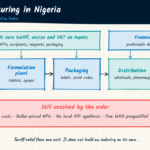
An Executive Order signed in June 2024 provides tax and tariff relief on specified machinery, equipment and inputs for local healthcare manufacturing. More than N24 billion in waivers was approved for 75 manufacturers between January 2025 and June 2026, according to the article.
Factories, nets and diagnostics
Ten factories producing priority health products are being established, six of them so far in 2026, Tinubu wrote. Products include medicines, diagnostic tests, medical oxygen and mosquito nets.
Health Textiles Nigeria, linked to Vestergaard, began operations in September 2026, and Harvestfield is producing dual-ingredient nets. At full scale, the companies are expected to produce more than 10 million nets a year and employ more than 600 people, according to the article.
Codix Bio’s agreement with the Medicines Patent Pool, supported by WHO, provides for technology transfer from SD Biosensor to make rapid diagnostic tests in Nigeria, and NASENI-Troment is also producing diagnostic kits locally, he wrote.
Tinubu also cited Medipool, which he described as Nigeria’s first nationally approved group purchasing organisation, intended to pool demand, negotiate prices and give local manufacturers a more dependable market.
Costs remain a hurdle
The article acknowledged that manufacturers still face high costs and that new capacity will take time to benefit patients. “Government support must result in better products and affordable services for Nigerians,” Tinubu wrote.
Nigerian drug makers have previously said that energy costs consume a large share of their revenue, as HealthCoach Africa has reported on the impact of power costs on local manufacturers. Access to foreign exchange for imported raw materials, and the cost of meeting international quality standards, are other challenges commonly cited by the industry.
As general background, most active pharmaceutical ingredients used by Nigerian manufacturers are imported, mainly from India and China. Building a full Nigeria healthcare value chain would require local production of some of these inputs, not only finished products.
What patients could gain
If local production expands as planned, patients could benefit from more reliable supply and prices that are less affected by currency swings. Locally made mosquito nets and diagnostic tests could support malaria control, while local oxygen production could help hospitals treat severe pneumonia and other emergencies.
For people living with chronic conditions such as diabetes and hypertension, affordable and reliable access to medicines is essential. Pooled purchasing through Medipool could lower prices if it achieves sufficient scale.
Pharmacies and coordinated care providers that serve chronic patients could also benefit from more predictable local supply, which reduces the risk of stock-outs that force patients to switch brands or miss doses. The Nigeria healthcare value chain plan will be judged by whether such stock-outs become less common.
As general background, regional pooled procurement is also gaining ground elsewhere in Africa. Southern African health ministers signed a charter for a regional pooled procurement service in Durban last week, reflecting a wider push for African countries to secure their own medicine supply.
The figures in the article are the government’s own and were not independently verified in the text. Their impact will depend on whether announced investments turn into working factories and products that reach pharmacies and hospitals. “Good health is fundamental to the prosperity we seek,” Tinubu wrote.
Why it matters: Local production could cushion Nigerian patients from currency shocks, but only if investments become affordable products in pharmacies and hospitals.
Nigeria Grants Drug Manufacturers N24bn in Tax… ABUJA, NIGERIA Nigeria granted pharmaceutical manufacturers tax waivers worth N24 billion in 2025 and 2026 under a presidential executive order to boost local production of medicines and health products, Coordinating Minister of Health and Social…
Drug Manufacturing in Nigeria: Is the Executive… When the naira lost more than half its value in 2023 and 2024, Nigerians felt it at the pharmacy counter before they felt it almost anywhere else. Prices of common medicines climbed sharply because most…
Diabetes in Nigeria: Why Blood Sugar Control Fails Diabetes in Nigeria does not usually fail in the clinic. Among people who reach a specialist and stay in care, control is often reasonable. It fails in the years before anyone tests you, and it…
Healthcare Trailblazer: Celebrating Pharm. Ahmed… On December 1st, 1960, amidst the joy and jubilation in the Yakasai community of Kano, Nigeria, a beacon of excellence, leadership, and dedication was born. Pharm. Ahmed Ibrahim Yakasai, FPSN, mni, FNIM, FPCPharm, FNAPharm, a…