A glucose meter turns diabetes care from guesswork into clear information. It shows how food, activity, stress and medicines affect your blood sugar. It warns you when sugar is too low or too high. Yet many people use their meters wrongly or rarely look at the results. This guide explains home blood sugar testing step by step, when to test, what the numbers mean and how to avoid common mistakes.
Why test at home?
Clinic tests show your blood sugar at one moment, or as an average over three months with HbA1c. Home blood sugar testing fills in the gaps. It helps you:
See how different meals affect you
Spot low blood sugar early, especially if you use insulin or some tablets
Adjust insulin doses safely, with guidance from your team
Understand the effect of illness, stress and exercise
Give your doctor accurate information at each visit
What you need
A glucose meter
Test strips that match your meter
A lancing device and fresh lancets
A logbook, notebook or phone app to record results
A safe container for used lancets
Buy meters and strips1 only from licensed pharmacies. Fake or expired strips give wrong readings, which can lead to dangerous decisions.
Home blood sugar testing: step by step
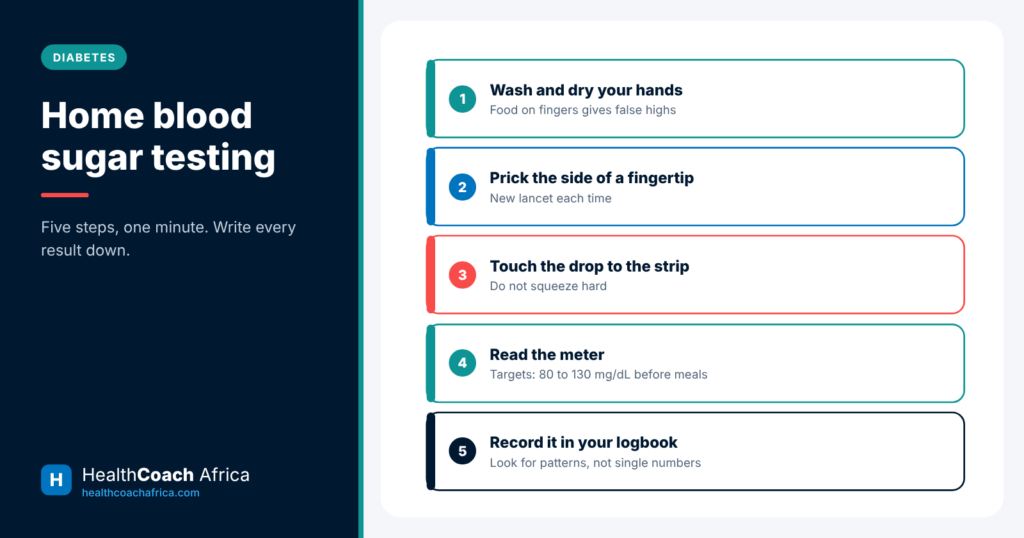
Wash your hands with soap and warm water, then dry them well. Food on your fingers, especially fruit, can give a falsely high reading.
Prepare the lancing device with a new lancet and set the depth.
Insert a test strip into the meter. Check that the meter is ready.
Prick the side of your fingertip, not the pad. The sides have fewer nerve endings, so it hurts less.
Gently squeeze from the base of the finger to form a small drop of blood. Avoid pressing hard at the tip.
Touch the drop to the strip and wait for the result.
Record the reading, with the date, time and any notes, such as a meal or exercise.
Dispose of the lancet safely in a hard container.
Rotate fingers to avoid sore spots. Use the middle, ring and little fingers more often than the thumb and index finger.
HUBPHARM PHARMACIST’S NOTE
Fake and expired test strips are common, and they give readings that look normal when sugar is high, or the other way round. Order genuine meters, strips and lancets from HubPharm. Every pack comes from a verified supplier and is stored correctly. Send us a photo of your logbook once a month, and a pharmacist will help you spot patterns and decide what to discuss with your doctor. If your meter seems wrong, we can also show you how to check it with control solution.
When to test
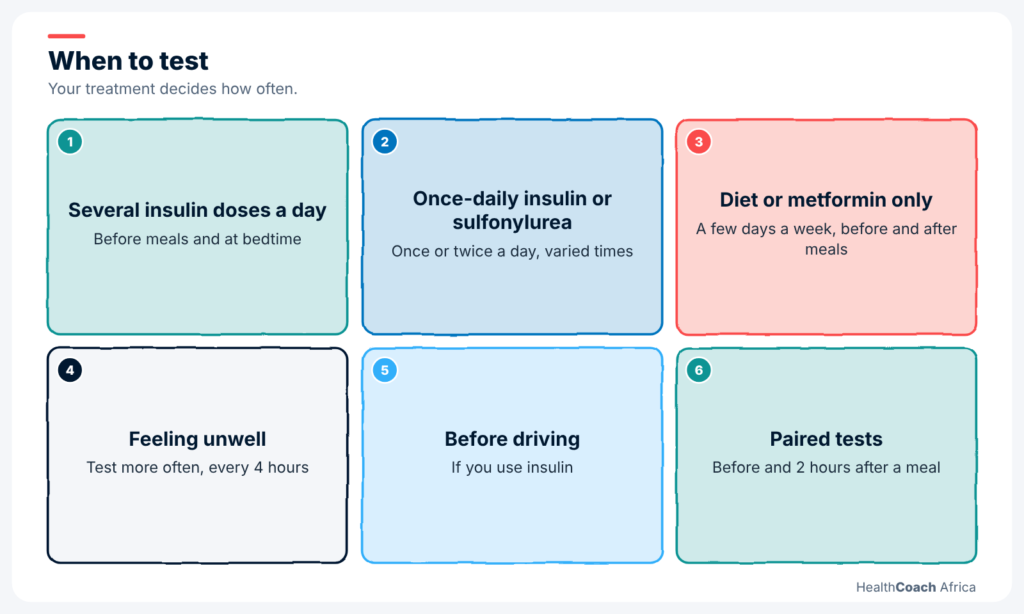
Testing schedule for home blood sugar testing by treatment type, from insulin to diet only
Agree your own testing plan with your diabetes team.
How often you test depends on your treatment. Your team will advise you. Common patterns include:
On insulin several times a day: before each meal and at bedtime, and sometimes during the night
On once-daily insulin or tablets that can cause lows: once or twice a day at different times
On diet or metformin alone: occasional checks, such as a few days each week before breakfast and two hours after a main meal
Always: when you feel unwell, shaky, sweaty or confused, and before driving if you use insulin
Testing in pairs, before and two hours after a meal, shows how that meal affects you.
What do the numbers mean?
Targets differ between people, so follow your team’s advice. Common targets for many adults are:
Before meals: 80 to 130 mg/dL (4.4 to 7.2 mmol/L)
Two hours after starting a meal: below 180 mg/dL (10 mmol/L)
Nigerian meters usually show mg/dL. Some imported meters show mmol/L. To convert mmol/L to mg/dL, multiply by 18.
What to do with a low reading
If your reading is below 70 mg/dL, or you have symptoms of a low, act quickly:
Take fast-acting sugar, such as glucose tablets2, half a glass of fruit juice or three teaspoons of sugar dissolved in water.
Recheck after 15 minutes.
If it is still below 70 mg/dL, repeat the sugar.
Once it is back up, eat a snack or meal with starch, such as bread.
If a person is drowsy or unconscious, do not give anything by mouth. Call for emergency help.
What to do with a high reading
A single high reading after a big meal is not an emergency. Drink water, stay active and recheck later. Seek advice if readings stay above 250 mg/dL, especially with vomiting, fast breathing, abdominal pain or drowsiness. These may be signs of a dangerous complication, particularly in type 1 diabetes.
Home blood sugar testing during illness
Illness, such as malaria, a chest infection or diarrhoea, often raises blood sugar, even if you are eating less. During illness, test more often, about every four hours. Keep drinking fluids. Do not stop insulin without advice. Your team may give you sick day rules, which explain how to adjust medicines when you are unwell. Seek help if readings stay high, you are vomiting or you cannot keep fluids down.
Home blood sugar testing for children
Children with diabetes need regular testing at home and at school. Teach older children to test themselves as soon as they are able. Make sure teachers know how to recognise and treat low blood sugar. Keep a spare meter, strips and glucose tablets at school.
Common mistakes to avoid
Not washing hands before testing
Using expired or damp test strips
Leaving strips in a hot car or sunny window
Squeezing the finger too hard, which dilutes the blood
Reusing lancets, which become blunt and painful
Using strips meant for a different meter
Never looking at the results
Store strips in their original container with the lid closed. Write the date you opened a new container on the label.
Making sense of your records
Look for patterns, not single numbers. Are your morning readings always high? Do readings spike after certain foods? Do lows happen at the same time each day? Bring your logbook or meter to every visit. Your doctor can use these patterns to adjust treatment safely.
Checking your meter’s accuracy
If a reading does not match how you feel, wash your hands and test again. Compare your meter with a laboratory test from time to time. Some meters come with control solution to check that the meter and strips are working. Replace a meter that has been dropped or damaged.
Making testing easier
Finger pricks can feel uncomfortable, but a few tips help. Use the lowest depth setting that gives enough blood. Warm your hands first by washing them in warm water. Prick the sides of the fingertips. Change lancets regularly. Keep your testing kit in one bag so it is always ready.
Cost-saving tips
Test strips can be costly. Plan your tests with your doctor so that each one answers a question. Buy strips in packs from a trusted pharmacy, store them properly and check expiry dates. Avoid cheap strips from unregistered sellers. Good planning makes home blood sugar testing affordable without losing useful information.
Continuous glucose monitors
Continuous glucose monitors use a small sensor worn on the arm or belly. They measure sugar every few minutes and show trends on a reader or phone. They are becoming more available in Nigeria but are still costly. For most people, careful home blood sugar testing with a meter gives the information needed.
Share your numbers
Share your readings with a family member, especially if you live alone. They can help you notice patterns and respond quickly to a low.
Buy from licensed pharmacies. Store strips in their closed container.
2
Glucose tablets
Over the counter
Fast treatment for a reading below 70 mg/dL.
To order any of these, or to ask a pharmacist a question first, message HubPharm on WhatsApp or visit hubpharmafrica.com. Prescription medicines are supplied against a valid prescription.
What HbA1c Results Mean for Your Diabetes Care If you have diabetes, or your doctor suspects it, you will hear a lot about the HbA1c test. It is one of the most important numbers in diabetes care. Yet many people do not know…
Normal Blood Sugar Levels: What Your Numbers Mean Someone checks your sugar at a chemist, reads out a number, and either looks worried or does not. Nobody explains which test it was, which units it is in, or what the threshold actually is.…
Childhood Type 1 Diabetes: A Guide for Nigerian Families Many people think diabetes only affects older, overweight adults. However, children can develop diabetes too, and most children with diabetes have type 1. In Nigeria, childhood type 1 diabetes is often missed until the child…
Diabetes in Nigeria: Why Blood Sugar Control Fails Diabetes in Nigeria does not usually fail in the clinic. Among people who reach a specialist and stay in care, control is often reasonable. It fails in the years before anyone tests you, and it…