Malaria medicines are among the most commonly bought medicines in Nigeria. Yet many people take them incorrectly. They skip doses, stop when they feel better, take them without food or buy them from unreliable sellers. These mistakes can lead to treatment failure and help resistant parasites to spread. This pharmacist’s guide explains how to take antimalarials correctly, so that each course works the first time.
Step one: test before you treat
Not every fever is malaria. Typhoid, urine infections, chest infections and viral illnesses can all cause similar symptoms. Taking antimalarials when you do not have malaria wastes money and delays the right treatment.
A rapid diagnostic test 1 or a blood film confirms malaria. Rapid tests are available at clinics and many pharmacies, and give a result in about 15 minutes. If the test is negative but you remain unwell, see a doctor to find the real cause.
The recommended treatment: ACTs
For uncomplicated malaria, the World Health Organization recommends artemisinin-based combination therapies, known as ACTs. Each ACT combines a fast-acting artemisinin medicine with a longer-acting partner drug. The first clears most parasites quickly, and the second removes those that remain.
ACTs commonly used in Nigeria include:
Artemether-lumefantrine
Artesunate-amodiaquine 2
Dihydroartemisinin-piperaquine 3
All three are taken over three days. Your doctor or pharmacist will choose the right one for you.
How to take artemether-lumefantrine
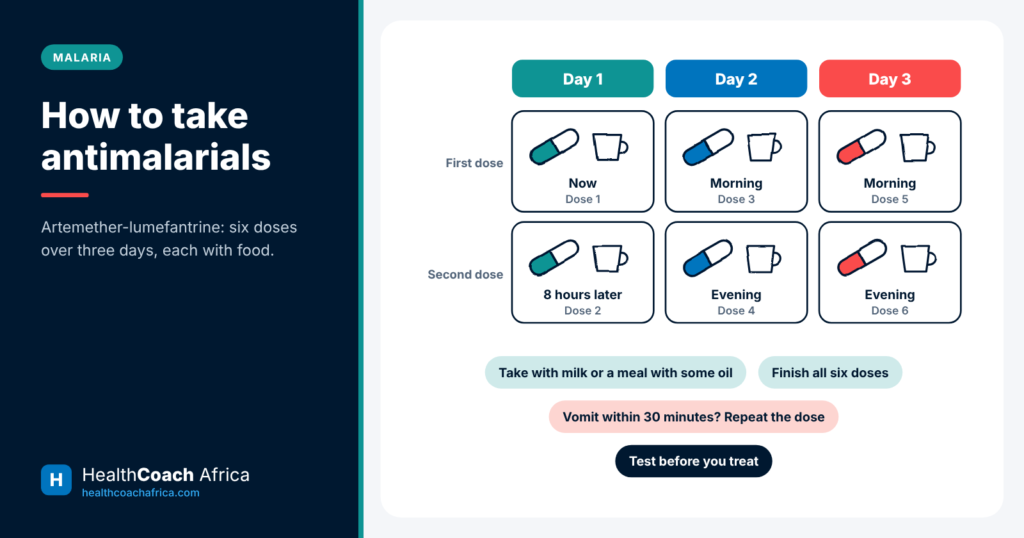
Artemether-lumefantrine is the most 4 widely used ACT in Nigeria. It is taken as six doses over three days:
First dose as soon as possible after diagnosis
Second dose 8 hours later
Third to sixth doses every 12 hours, morning and evening, on days two and three
Take each dose with food or a drink containing some fat, such as milk, pap with milk or a meal with oil. Fat helps the body absorb lumefantrine. Taking it on an empty stomach can reduce how well it works.
How to take the other ACTs
Artesunate-amodiaquine is taken once a day for three days. Amodiaquine can cause tiredness, weakness or nausea, so taking it after food may help.
Dihydroartemisinin-piperaquine is also taken once a day for three days. It is best taken with water and a light meal, and not with a heavy, high-fat meal.
Always check the leaflet and the label, because brands differ. If you are unsure how to take antimalarials you have been given, ask your pharmacist before the first dose.
Complete the full course
Most people feel better within one to two days of starting treatment. This is when many stop taking their tablets. However, parasites are still present at that point. Stopping early allows the toughest parasites to survive, multiply and cause the illness to return. Over time, it also encourages resistance.
Therefore, finish every dose of the three-day course, even if you feel completely well. Do not save tablets for another time or share them with family members.
What to do if you vomit
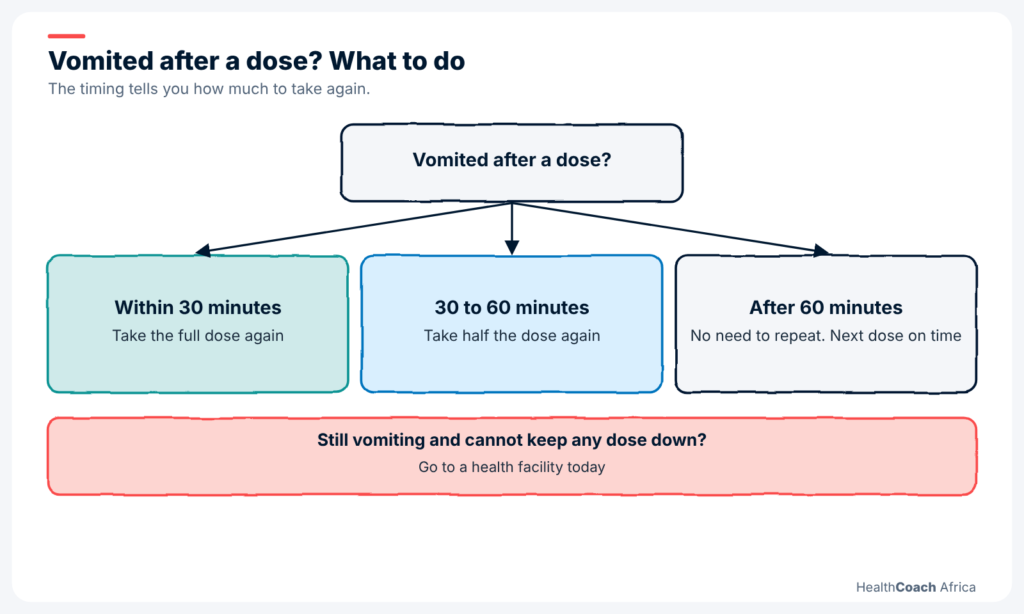
Vomiting is common with malaria. If you vomit within 30 minutes of taking a dose, take the full dose again. If you vomit between 30 and 60 minutes after a dose, take half the dose again. If vomiting continues and you cannot keep tablets down, go to a health facility. You may need treatment by injection.
Decision chart for vomiting after a dose, part of how to take antimalarials correctly
If vomiting continues and no dose stays down, go to a health facility. Injectable treatment may be needed.
Getting the dose right for children
Children’s doses depend on body weight. Use the dispersible tablets or syrup made for children, and follow the weight bands on the pack. Give medicine with breast milk, formula or food as advised. If your child vomits, follow the same rules as above, and seek help quickly if vomiting continues.
How to take antimalarials: a simple daily plan
Many people find it easier to follow a written plan. For artemether-lumefantrine started at 8 am on Monday, the plan would be:
Monday: 8 am with breakfast, then 4 pm with a snack containing milk or oil
Tuesday: 8 am and 8 pm, each with food
Wednesday: 8 am and 8 pm, each with food
Write the times on the pack or set phone alarms. Tick off each dose as you take it. If you remember a missed dose within a few hours, take it as soon as possible, then continue the schedule. Ask your pharmacist if you are unsure.
Avoid these common mistakes
Knowing how to take antimalarials safely also means avoiding:
Single-drug treatments. Artesunate tablets on their own, or chloroquine, should not be used to treat malaria.
Using SP to treat malaria. Sulfadoxine-pyrimethamine is used to prevent malaria in pregnancy and in some children, not to treat it.
Injections and drips for mild malaria. Uncomplicated malaria is treated with tablets. Injectable artesunate is reserved for severe malaria.
Mixing treatments. Do not take two different ACTs together, or add herbal mixtures, without advice.
HUBPHARM PHARMACIST’S NOTE Every ACT pack from HubPharm comes from a verified supplier, and a pharmacist writes the dose times on the box for you. If you already have a pack and are unsure about it, send us a photo of the box and the NAFDAC number. We will help you check it before you take the first dose.
How to spot fake antimalarials
Fake and substandard antimalarials are a serious problem in many countries. To protect yourself:
Buy from a licensed pharmacy or a registered health facility
Check that the pack has a NAFDAC registration number
Use the scratch-and-text authentication code if the pack carries one
Look for spelling errors, poor print quality, damaged seals and unusual tablet colours
Be wary of very cheap prices and unlabelled tablets
If you suspect a fake product, report it to your pharmacist or to NAFDAC.
Side effects and when to return
Most people have mild side effects or none at all. Some feel dizzy, sick, tired or lose their appetite. Paracetamol can help with fever and body aches.
Return to a health worker if:
You are not improving after 48 to 72 hours of treatment
Your symptoms return within a few weeks
You develop danger signs such as confusion, fits, difficulty breathing, yellow eyes, dark urine or inability to drink
Storing your medicines
Heat and humidity can damage medicines. Keep antimalarials in their original pack, in a cool, dry place away from direct sunlight and out of the reach of children. Do not keep them in a hot car or near a cooking area. Check the expiry date before use, and do not use tablets that have changed colour, crumbled or become damp.
Preventing the next infection
Treatment cures the current infection, but it does not stop you from getting malaria again. Sleep under an insecticide-treated net every night, clear stagnant water near your home and fit screens to windows where possible. Learning how to take antimalarials correctly, together with prevention, keeps you and your family healthier. People who travel to Nigeria from countries without malaria need preventive tablets, so they should ask a doctor about the right option before travel.
A pharmacist’s final checklist
Before you leave the pharmacy, make sure you know how to take antimalarials you have been given. You should be able to answer these questions: How many tablets per dose? How many doses in total? Should I take them with food? What do I do if I vomit? When should I come back? If you cannot answer any of these, ask again.
Special groups
Pregnant women, babies under 5 kg and people with other medical conditions need tailored advice. Artemether-lumefantrine is now recommended in all three trimesters of pregnancy. People taking medicines for HIV, tuberculosis or epilepsy should tell their pharmacist, because some of these interact with antimalarials.
Confirms malaria in about 15 minutes before treatment is started.
2
Artesunate-amodiaquine
Prescription only
Once daily for three days. It can cause tiredness or nausea.
3
Dihydroartemisinin-piperaquine
Prescription only
Once daily for three days. Take with water and a light meal, not a heavy fatty one.
4
Artemether-lumefantrine
Prescription only
Six doses over three days. Take each dose with food or milk.
To order any of these, or to ask a pharmacist a question first, message HubPharm on WhatsApp or visit hubpharmafrica.com. Prescription medicines are supplied against a valid prescription.
Malaria and Typhoid Fever: How to Tell Them Apart… "You have malaria and typhoid." It is one of the most common diagnoses given in Nigeria, and millions of people are treated for both at the same time. Yet malaria and typhoid fever are two…
Lassa Fever Warning Signs: Early Action Saves Lives Lassa fever is a viral illness that is found in West Africa, and Nigeria reports more cases than any other country. Each year, outbreaks peak during the dry season, from about December to April. In…
Urinary Tract Infection Symptoms, Causes and Treatment A burning feeling when you pass urine is hard to ignore. Urinary tract infections, or UTIs, are among the most common bacterial infections, and at least half of all women will have one at some…
Malaria: Understanding Symptoms, Treatment,… In this article, we will discuss the symptoms, treatment and prevention of malaria. Furthermore, we will highlight global efforts and challenges in eradicating malaria in our world Malaria, a life-threatening mosquito-borne disease, continues to…