In Nigeria, almost every fever is treated as malaria. Many people buy antimalarials without being tested, and many are treated for malaria when they actually have another illness. The malaria rapid diagnostic test changes this. It is a simple, quick test that confirms whether malaria parasites are present. This guide explains how the test works, how to read the result and how to use it wisely.
Malaria rapid diagnostic test at the pharmacy
Many community pharmacies in Nigeria now offer malaria testing. This allows people to confirm malaria before buying medicine. A trained pharmacist can perform the test, read the result and recommend the right treatment. If the result is negative, the pharmacist can advise you on other possible causes and refer you to a doctor when needed. Testing at the pharmacy takes about 20 minutes and is usually affordable.
Why testing matters
The World Health Organization recommends that every suspected case of malaria be confirmed with a test before treatment. Testing helps in several ways:
It confirms who needs antimalarial treatment
It points to other causes of fever, such as typhoid, urine infections or pneumonia, when the test is negative
It avoids wasting money on unnecessary medicines
It slows the spread of drug resistance
What a malaria rapid diagnostic test is
A malaria rapid diagnostic test, or RDT, is a small plastic cassette 1 that detects proteins released by malaria parasites in a drop of blood. It works in a similar way to a pregnancy test. Results are ready in about 15 to 20 minutes. No laboratory or electricity is needed.
Many RDTs used in Nigeria detect a protein called HRP2, which is made by Plasmodium falciparum, the parasite responsible for most malaria cases in the country. Some tests also detect other malaria species.
How the test is done
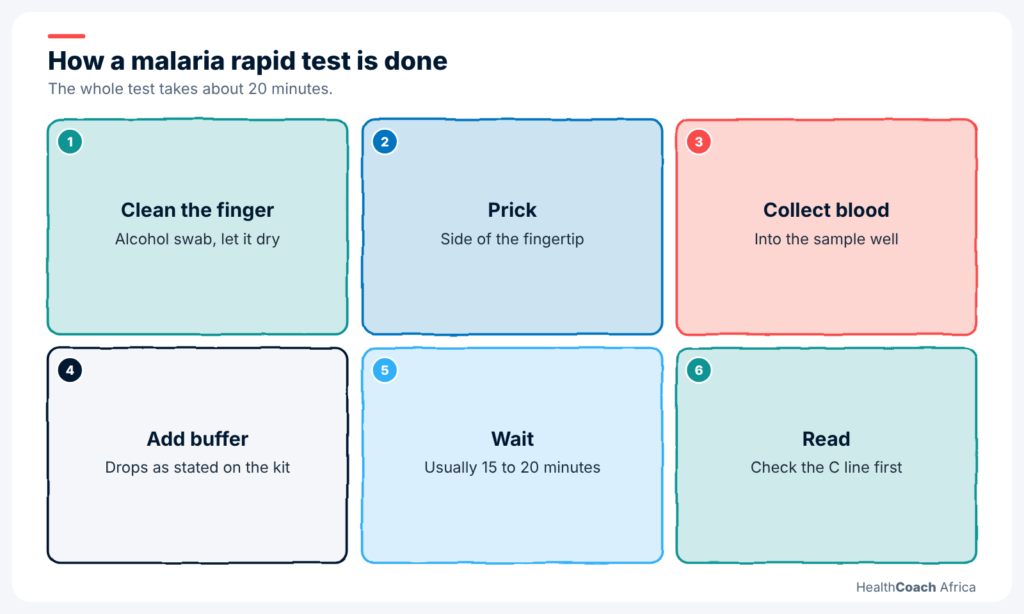
The health worker checks the expiry date and opens a new test kit.
They clean your fingertip and prick it with a sterile lancet.
A small drop of blood is placed in the sample well.
Drops of buffer solution are added.
After the time stated in the instructions, usually 15 to 20 minutes, the result is read.
Reading the result too early or too late can give a wrong answer.
Follow the timing on your kit exactly. Reading too early or too late can mislead.
How the test is done” section. Alt text: Six steps of a malaria rapid diagnostic test, from finger prick to reading the result
How to read the result
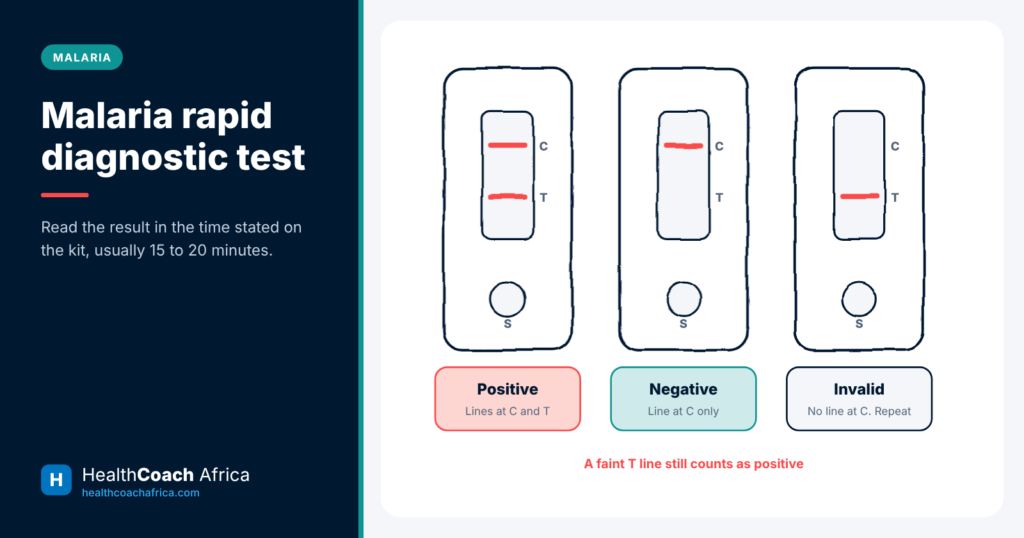
The test window has a control line, usually marked C, and one or more test lines, usually marked T.
Positive: a line appears at C and a line appears at T. Even a faint T line counts as positive.
Negative: a line appears at C only.
Invalid: no line appears at C. The test has failed and must be repeated with a new kit.
HUBPHARM PHARMACIST’S NOTE Every HubPharm pharmacy offers a malaria test before treatment, and our pharmacists are trained to read faint lines correctly. If you have a kit at home and are unsure about the result, send a clear photo of the cassette to a HubPharm pharmacist within the reading time, and we will help you interpret it.
What a negative result means
A negative malaria rapid diagnostic test means malaria is unlikely. If you are still unwell, the health worker should look for other causes. If symptoms continue and malaria is still suspected, the test may be repeated or a blood film examined under a microscope.
Why the test can stay positive after treatment
The HRP2 protein can remain in the blood for two to four weeks, or longer, after successful treatment. This means a test can stay positive even after malaria has been cured. If you were treated for malaria recently and feel unwell again, tell the health worker. A blood film may be more useful in this situation.
RDTs and blood films
Microscopy, where a trained technician looks at a stained blood film under a microscope, is the traditional way to diagnose malaria. It can count the number of parasites and identify the species. However, it requires a laboratory, equipment and skilled staff. RDTs are faster and easier to use, which is why they are widely used in clinics, pharmacies and communities.
Can you use an RDT at home?
Malaria RDTs are designed for use by trained health workers, including pharmacy staff and community health workers. Some people buy kits and test themselves. If you do, follow the instructions exactly, read the result at the correct time and dispose of the lancet safely. If you are unsure about the result, or still feel unwell, see a health worker.
Common mistakes when using RDTs
Reading the result too early or too late
Using too much or too little blood
Adding the wrong number of buffer drops
Using an expired or damaged kit
Ignoring a faint test line
Reusing a lancet
Each of these can lead to a wrong result. Follow the instructions in every malaria rapid diagnostic test kit carefully.
Testing children
Children can be tested in the same way. For babies, the heel may be used instead of a finger. Young children can become seriously ill quickly, so test promptly and do not delay treatment if the test is positive.
Testing in pregnancy
Pregnant women with fever should always be tested. Malaria in pregnancy can harm both mother and baby. A malaria rapid diagnostic test is safe in pregnancy.
What to do after a positive result
If the test is positive, take the full course of an artemisinin-based combination therapy 2 as prescribed. Take each dose at the right time, with food if advised. Finish all doses even if you feel better. Return if you are not improving after two to three days or if danger signs appear. Learn more in our guide to malaria symptoms, treatment and prevention.
Danger signs that need hospital care
Whatever the test result, go to hospital immediately if there is:
Confusion or drowsiness
Fits
Difficulty breathing
Inability to drink or keep fluids down
Yellow eyes or dark urine
Severe weakness
When the malaria rapid diagnostic test is negative but you feel ill
A negative result is useful information. Common causes of fever with a negative malaria test include typhoid, urinary tract infections, chest infections, viral illnesses such as flu, and dengue. A health worker can examine you and arrange other tests. Do not take antimalarials “just in case”. This wastes money and delays the right treatment.
Why one test is better than three treatments
Many families buy antimalarials several times a year without testing. Over a year, the cost of repeated treatment can be far higher than the cost of a test. Testing first saves money, avoids side effects and protects the effectiveness of malaria medicines. Asking for a malaria rapid diagnostic test every time someone has a fever is a smart habit.
Storing test kits
RDTs can be damaged by heat and humidity. Store them in a cool, dry place, away from direct sunlight. Check the expiry date. Do not use a kit if the packet is damaged or the desiccant sachet has changed colour.
Questions to ask at the pharmacy
Is this test kit genuine and in date?
How long will the result take?
What does my result mean?
If it is positive, which treatment do I need and how do I take it?
If it is negative, what else could be causing my fever?
Clear answers help you act on your result with confidence.
Myths about malaria testing
“Every fever in Nigeria is malaria.” Many fevers have other causes, and testing helps find them.
“A negative test is always wrong.” Good-quality tests used correctly are reliable.
“A faint line means the test is negative.” Any visible test line, however faint, is positive.
Testing in rural communities
In many villages, community health workers carry test kits and treat confirmed malaria close to home. This saves travel time and money, and stops unnecessary use of antimalarials. Ask whether a trained worker in your area offers the malaria rapid diagnostic test.
Getting help
A malaria rapid diagnostic test before treatment protects your health and your pocket. For genuine RDT kits, help reading a result, or advice on the right antimalarial, message a HubPharm pharmacist or ask Afiya on WhatsApp.
Medicines and products in this article
#
Medicine or product
What to know
1
Malaria rapid diagnostic test kit
Pharmacy and clinic
Detects malaria parasite proteins in about 15 to 20 minutes.
2
Artemisinin-based combination therapy
Prescription only
Full three-day treatment for confirmed malaria.
To order any of these, or to ask a pharmacist a question first, message HubPharm on WhatsApp or visit hubpharmafrica.com. Prescription medicines are supplied against a valid prescription.
How to Take Antimalarials Correctly and Avoid… Malaria medicines are among the most commonly bought medicines in Nigeria. Yet many people take them incorrectly. They skip doses, stop when they feel better, take them without food or buy them from unreliable sellers.…
Lassa Fever Warning Signs: Early Action Saves Lives Lassa fever is a viral illness that is found in West Africa, and Nigeria reports more cases than any other country. Each year, outbreaks peak during the dry season, from about December to April. In…
Medical Record Officer at Solid Rock Hospital Since our beginning, our secret at Solid Rock Hospital (SRH) has been our foundation which was built based on the principles of Christ. We have continued in this pursuit, which equips us to serve our clients…
Optometric at Usman Dan Fodiyo University Teaching Hospital The Hospital, which started operating in the present Sokoto Specialist Hospital has witnessed transformations and growth since then. It is gratifying to note that its growth has translated into the provision of Tertiary Health care…