I have attended more farewell gatherings for pharmacists in the last five years than in the fifteen before them. Each one ends the same way: a toast, a group photograph, and a quiet calculation in my head about which patients will now wait longer for help. Nigeria health worker migration is no longer a story about a few ambitious doctors. It is a structural feature of our health system, and I want to argue that our response to it has been aimed at the wrong target.
The scale is not in dispute
The numbers have been repeated so often that they risk becoming background noise, so it is worth stating them plainly.
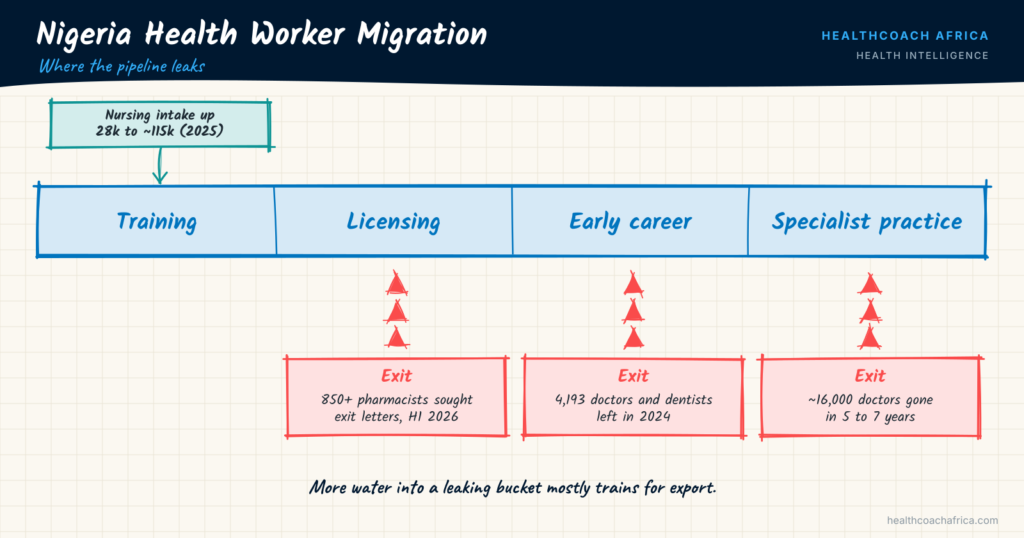
The Coordinating Minister of Health has said that around 16,000 doctors left Nigeria in five to seven years, leaving roughly 55,000 licensed doctors for a population above 220 million. The federal government’s 2025 Joint Annual Review recorded that external migration across all health worker cadres rose by 200% between 2023 and 2024, and that 4,193 doctors and dentists left in 2024 alone, about two thirds of them to the United Kingdom.
My own profession is not spared. The Association of Community Pharmacists of Nigeria reported this year that about 9,000 pharmacists emigrated in the four and a half years to December 2025, and that more than 850 collected letters of good standing from the Pharmacists Council of Nigeria in the first six months of 2026 alone. Nurses and midwives are leaving in large numbers too. The UK’s Nursing and Midwifery Council added 2,363 people trained in Nigeria to its register in the year to March 2025.
These are not people fleeing their work. They are people taking it somewhere it is better paid, better equipped and safer to do.
Why the usual answers fall short
Our public debate tends to offer three responses.
The first is to stop them. Bills have been proposed to force graduates to serve several years in Nigeria before receiving full licences. I understand the frustration behind them, but bonding professionals only delays departure and teaches young people that the system sees them as property. It will push the brightest to plan their exit earlier.
The second is to pay them more. Better pay is necessary and overdue. But we should be honest: Nigeria will not match a London or Toronto salary in the next decade, and probably not in the next two. A strategy that depends on winning a salary race we cannot win is not a strategy.
The third is to train more. Nursing school enrolment has been expanded dramatically, from about 28,000 in 2023 to an estimated 115,000 in 2025. That is welcome, but if we pour more water into a leaking bucket without fixing the leak, we are mostly training for export.
Each of these treats Nigeria health worker migration as a supply problem. I believe it is equally a design problem.
The question we should be asking
Instead of asking how to keep every professional, we should ask how to make every professional who stays reach far more patients than they do today.
Consider how a chronic care patient is served now. A person with hypertension sees a doctor, collects a prescription, buys whatever the nearest shop has in stock, and then disappears until something goes wrong. The doctor’s time, the scarcest resource we have, was spent on a ten-minute consultation, and the system around it did nothing to protect that investment. Multiply that by millions of patients and you see why we feel short of staff even before anyone boards a plane.
A redesigned system would spend professional time differently.
Three levers that respond to Nigeria health worker migration
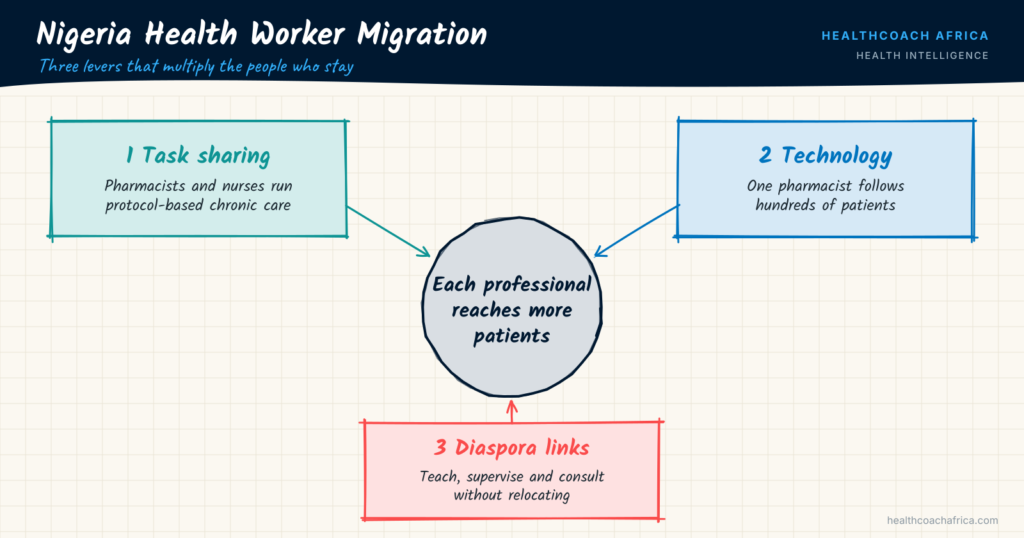
Three levers that let the professionals who stay reach more patients.
Three redesign levers that respond to Nigeria health worker migration: task sharing, technology and diaspora links
Task sharing with clear protocols. Many tasks done by doctors can be done safely by pharmacists, nurses and trained community health workers when protocols are clear and escalation routes exist. Refilling a stable patient’s antihypertensive, checking blood pressure, counselling on side effects and spotting danger signs do not need a consultant. The pharmacist, the most accessible health professional in most Nigerian communities, is ready for a larger clinical role. Our policy simply has not caught up.
Technology that multiplies reach. One pharmacist supported by good software can monitor hundreds of chronic care patients: who is due for a refill, who missed one, whose readings are drifting. Messaging tools let that pharmacist answer quick questions in seconds instead of in a queue. Technology does not replace the professional. It removes the work that does not need one.
Bring the diaspora back in, without asking them to move. Many Nigerian professionals abroad want to contribute at home. Tele-consultation, remote second opinions, protocol design, teaching and supervision can all happen across borders. We should build formal, paid channels for this instead of treating everyone who left as lost.
What I have learned building this model
At HubPharm Africa we built our chronic care platform around this idea, partly out of conviction and partly out of necessity. We could not hire an army. We have 15 staff. Yet that team, anchored by licensed pharmacists and supported by technology, has served more than 10,200 patients and dispensed over 400,000 medicine packs. Among the patients we follow, adherence to treatment has improved by 42%.
I do not share those numbers to suggest we have solved anything. They are small against the need. I share them because they show what a pharmacist-led, technology-supported model can do with a lean workforce. That is the model our health system will need whether or not the migration slows.
What I am asking for
To government: give pharmacists and nurses clear legal scope for protocol-based chronic care, and pay for it through the national health insurance scheme. Fund digital tools at primary health care level, not just buildings.
To employers: compete on things you can control, such as respect, training, career paths and safe workloads, not only on salary.
To my colleagues abroad: stay connected. Teach, supervise, review, invest. Your departure does not have to be the end of your contribution.
To those who stay: you are not the ones who failed to leave. You are the ones the redesign depends on.
A note from HubPharm. Our pharmacist-led chronic care team exists so that patients do not have to wait for a scarce doctor to get a monthly refill or an honest answer about their medicines. If you or a family member manage a long-term condition, send the code HC-TL01 on WhatsApp to +234 705 050 5001. Nigerian pharmacists and clinicians in the diaspora who want to support care at home can use the same code to reach us.
The bottom line
Nigeria health worker migration is real, painful and unlikely to reverse soon. We should keep fighting for better pay and conditions. But we should stop pretending that retention alone will save us. The countries that cope best with workforce shortages are those that redesign care so each professional’s skill reaches further. That redesign is within our control, and we should begin it now.
Views expressed are the author’s own. The author is the founder of HubPharm Africa, a sister company of HealthCoach Africa within the HubCare Global group.
World Health Organization. WHO health workforce support and safeguards list. Geneva: WHO; 2020 and 2023.
Please follow and like us:
Views:17
Related Posts:
Diabetes in Nigeria: Why Blood Sugar Control Fails Diabetes in Nigeria does not usually fail in the clinic. Among people who reach a specialist and stay in care, control is often reasonable. It fails in the years before anyone tests you, and it…
Breast Cancer Screening in Nigeria: Where to Go and Costs Breast cancer screening in Nigeria confuses people for a simple reason: nobody tells you which test you need. A woman of 32 asks for a mammogram and is told she does not need one. A…
Nutrition During Cancer Treatment: What to Eat and Why Cancer and its treatment place heavy demands on the body. Chemotherapy, radiotherapy and surgery all increase your need for energy and protein, while side effects such as nausea and mouth sores make eating harder. Good…
Cervical Cancer Screening Tests: A Clear Guide for… Cervical cancer is the second most common cancer among Nigerian women, with about 14,000 new cases and more than 7,000 deaths recorded each year. Almost all of those deaths are avoidable. Cervical cancer screening tests…