Imagine giving your child a full course of malaria medicine, only to find the fever getting worse. One reason this happens is fake or poor-quality medicine. Fake antimalarials may contain no active ingredient, too little of it or even harmful substances. They look almost identical to genuine packs and are often cheaper. Spotting fake malaria drugs is a skill every Nigerian family needs. This guide explains the risks, the warning signs and how to buy medicines safely.
Falsified (fake) medicines deliberately misrepresent their identity, ingredients or source.
Substandard medicines are genuine products that fail quality standards, sometimes because of poor manufacturing.
Degraded medicines were once good but have been damaged by heat, humidity or poor storage, or have expired.
All three can fail to cure malaria. Antimalarials and antibiotics are among the most commonly faked medicines in Africa.
Why fake antimalarials are so dangerous
Malaria goes untreated and can become severe within hours, especially in children.
Too little active ingredient can encourage drug resistance, making genuine medicines less effective for everyone.
Harmful ingredients can cause poisoning or serious side effects.
Families lose money and trust in genuine medicines.
Where fake drugs are sold
Fake medicines are most often found:
In open markets and roadside stalls
With hawkers on buses, in motor parks and on the street
In unlicensed shops
Through social media and unverified online sellers
At prices far below normal
Licensed pharmacies and registered health facilities are much safer, because they buy from approved suppliers and are inspected by regulators.
Spotting fake malaria drugs: check the pack
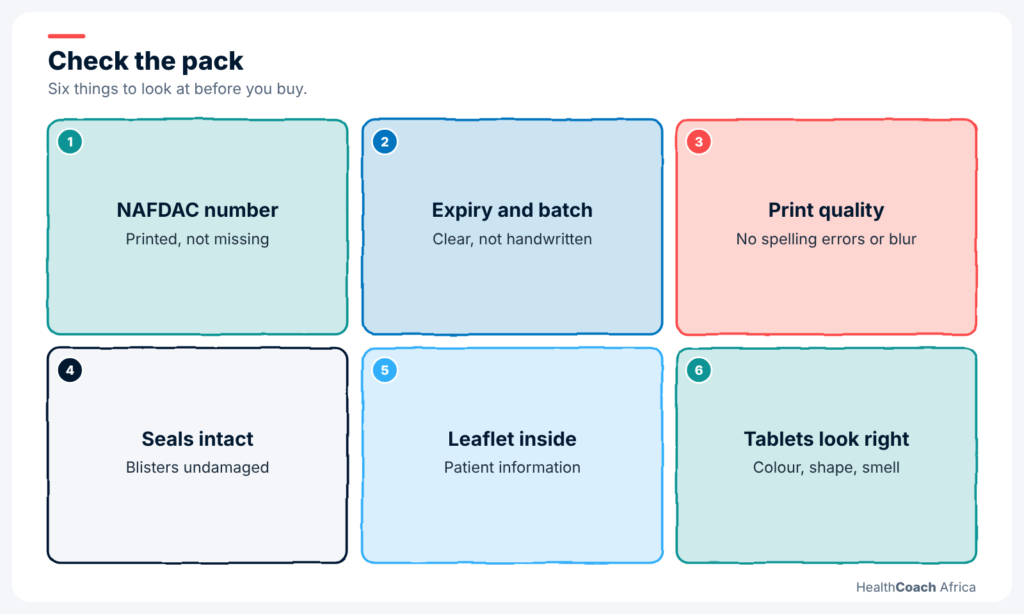
Pack inspection guide for spotting fake malaria drugs, from NAFDAC number to tablet appearance
If anything looks wrong, do not use it. Show it to a pharmacist.
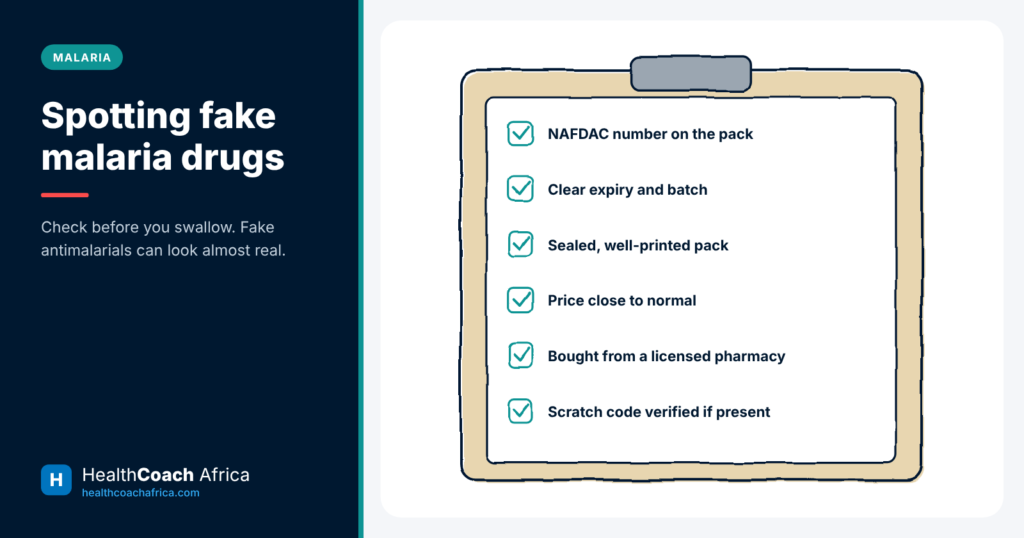
Look carefully at the packaging before you buy or use a medicine:
NAFDAC number. Every registered medicine in Nigeria should carry a NAFDAC registration number. Missing numbers are a red flag.
Expiry and batch numbers. These should be clearly printed, not handwritten or stuck on with a label.
Print quality. Look for spelling mistakes, blurred printing, faded colours or uneven fonts.
Packaging condition. Check for broken seals, damaged blister packs, or a pack that looks different from the one you usually buy.
Leaflet. Genuine packs usually include a patient information leaflet.
Tablets. Look for unusual colour, cracks, crumbling, a strange smell or tablets that differ from your usual brand.
HUBPHARM PHARMACIST’S NOTE
Not sure whether a pack in your cupboard is genuine? Send clear photos of the front, back and blister strip to a HubPharm pharmacist. We will check the NAFDAC number, batch and expiry details, compare the packaging with the genuine product and tell you whether it is safe to use or should be reported. Every antimalarial HubPharm supplies comes from a verified supplier and is stored correctly, so you can be confident that the medicine in your hand will work.
Use authentication tools
Some medicines in Nigeria carry a scratch panel with a code for the Mobile Authentication Service. You scratch the panel and send the code by text message to the number printed on the pack. A reply tells you whether the product is genuine.
You can also check whether a product is registered using NAFDAC’s online product database, called the Greenbook. If a product cannot be verified, do not use it.
Spotting fake malaria drugs online
More people now buy medicines through social media and online platforms. Some sellers are genuine pharmacies, but many are not. Before ordering, check that the seller is a registered pharmacy with a physical address and a licensed pharmacist. Avoid sellers who only accept unusual payment methods, refuse to give a receipt or offer prices that seem too good to be true. Spotting fake malaria drugs online needs the same care as in a shop.
Questions to ask your pharmacist
Is this medicine registered with NAFDAC?
Where was it sourced from?
Is this the right ACT and dose for me or my child?
How should I store it?
What should I do if the fever does not improve?
A good pharmacist will answer these questions willingly.
Price can be a warning sign
A pack sold at a much lower price than usual is suspicious. While prices vary between sellers, a very large discount often means the product is fake, expired or stolen. Quality medicines cost money to make, store and transport.
Storage matters too
Even genuine antimalarials can lose strength if stored badly. Heat, sunlight and moisture damage medicines. Keep medicines in a cool, dry place, away from direct sunlight, in their original packaging. Do not leave medicines in a hot car or near a window. Check expiry dates regularly and dispose of expired medicines safely.
Signs that a medicine may not be working
Spotting fake malaria drugs is not only about the pack. Be suspicious if:
Fever does not improve after two to three days of a full course
The medicine tastes or looks different from usual
New or unusual side effects appear
Return to a health worker, bring the pack with you and get tested again.
Spotting fake malaria drugs as a community
Fake medicines affect whole communities. Share these warning signs with family members, neighbours and community groups. Encourage people to buy from licensed outlets and to report suspicious products. Community health workers, religious leaders and teachers can help spread the message. When more people know about spotting fake malaria drugs, fake sellers lose customers.
Protecting your medicine cabinet
Keep a simple list of the medicines in your home, with their expiry dates. Throw away expired or damaged packs safely, rather than keeping them “just in case”. Keep medicines out of reach of children. A tidy, up-to-date medicine cabinet makes it easier to notice anything unusual.
How to report suspected fakes
If you suspect a fake medicine:
Stop using it.
Keep the pack, the remaining tablets and your receipt.
Tell the pharmacist or health worker who sold or prescribed it.
Report it to NAFDAC through its official channels or at a NAFDAC office.
Reporting helps regulators remove fake products and protect other families.
Buying antimalarials safely
Buy from licensed pharmacies, hospitals and registered health facilities
Ask the pharmacist for a recommended ACT1
Get tested before treatment
Check the pack, expiry date and NAFDAC number
Keep your receipt
Store medicines properly at home
Myths about fake drugs
“Foreign brands are always genuine.” Fakers copy popular foreign brands too.
“If it is expensive, it must be real.” Fake products are sometimes sold at normal prices.
“Market medicines are the same, just cheaper.” Medicines from unlicensed sellers carry a much higher risk.
“A drug that makes me feel something must be working.” Side effects do not prove a medicine is genuine.
What regulators are doing
NAFDAC inspects pharmacies and markets, seizes fake products and runs public awareness campaigns. It encourages the public to report suspicious medicines. Pharmaceutical companies also use tools such as scratch codes and tamper-evident packaging. These efforts work best when buyers are alert. Every report helps, so do not ignore a pack that looks wrong.
Questions to ask yourself before buying
Is this a licensed pharmacy or health facility?
Does the pack carry a NAFDAC number and clear expiry date?
Is the price close to what I normally pay?
Is the packaging sealed and undamaged?
If the answer to any of these is no, keep spotting fake malaria drugs in mind and buy elsewhere.
Share what you know
Tell family members, especially older relatives, how to check a pack. They are often the people targeted by hawkers selling cheap medicines.
Buy only from licensed outlets and check the NAFDAC number.
To order any of these, or to ask a pharmacist a question first, message HubPharm on WhatsApp or visit hubpharmafrica.com. Prescription medicines are supplied against a valid prescription.
Why Malaria Treatment Fails: Common Mistakes and How… "I treated malaria last week, but the fever is back." Pharmacists across Nigeria hear this every day. People often blame weak medicine and buy something stronger, or take a second course of a different drug.…
How to Take Antimalarials Correctly and Avoid… Malaria medicines are among the most commonly bought medicines in Nigeria. Yet many people take them incorrectly. They skip doses, stop when they feel better, take them without food or buy them from unreliable sellers.…
Lassa Fever Warning Signs: Early Action Saves Lives Lassa fever is a viral illness that is found in West Africa, and Nigeria reports more cases than any other country. Each year, outbreaks peak during the dry season, from about December to April. In…
NAFDAC Warns Imo Medicine Dealers Against Fake,… OWERRI, NIGERIA — The National Agency for Food and Drug Administration and Control (NAFDAC) has warned NAFDAC Imo medicine dealers against selling counterfeit, expired and unregistered drugs, saying violators face closure, forfeiture of products and…