You have had a thyroid blood test, and now you are holding a report full of letters and numbers: TSH, FT4, FT3, TPO. Some are marked high or low, and you are not sure what they mean. Understanding your thyroid function test results helps you follow your treatment and ask the right questions. This guide explains each test, the common patterns and when results need action.
How the thyroid is controlled
The thyroid gland in your neck makes two main hormones, thyroxine (T4) and triiodothyronine (T3). These control your metabolism. The pituitary gland in the brain controls the thyroid by releasing thyroid stimulating hormone (TSH).
The system works like a thermostat:
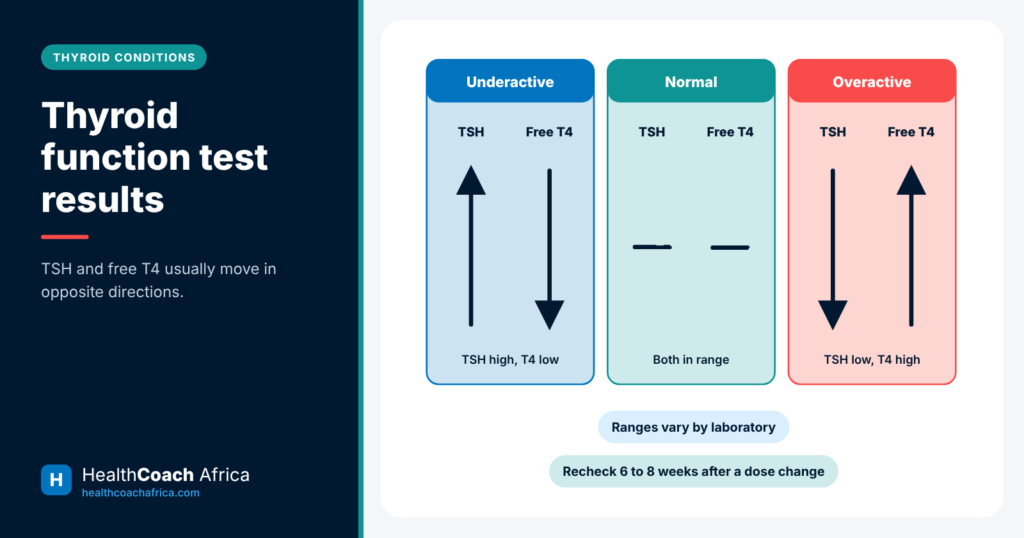
When thyroid hormone levels are low, the pituitary releases more TSH to push the thyroid to work harder.
When thyroid hormone levels are high, the pituitary releases less TSH.
This is why TSH and thyroid hormones usually move in opposite directions.
TSH: the first test
TSH is usually the first and most useful test. In many laboratories, the normal range for adults is roughly 0.4 to 4.0 mIU/L, but ranges vary between laboratories. Always compare your result with the range printed on your report.
High TSH usually means the thyroid is underactive.
Low TSH usually means the thyroid is overactive.
Normal TSH usually means the thyroid is working normally.
Free T4 and free T3
Most thyroid hormone in the blood is attached to proteins. The free part is the active hormone. Free T4 (FT4) and free T3 (FT3) measure this active hormone.
Low free T4 with high TSH confirms an underactive thyroid.
High free T4 or free T3 with low TSH confirms an overactive thyroid.
Free T3 is mainly useful when checking for an overactive thyroid.
Common thyroid function test results patterns
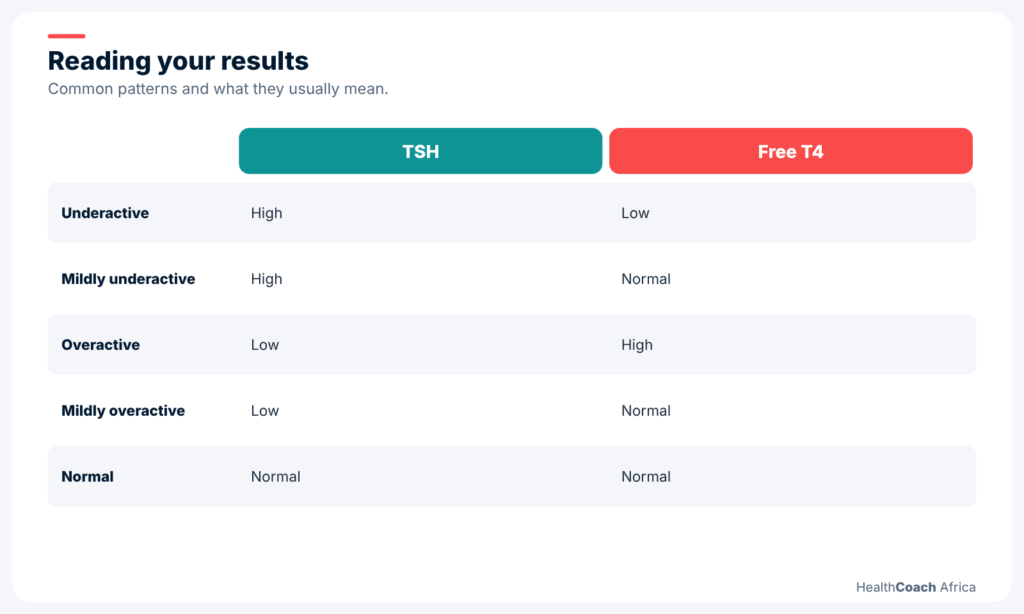
Guide to common thyroid function test results patterns, from high TSH to low TSH
Your doctor will interpret results alongside your symptoms and history.
Underactive (hypothyroidism): high TSH, low free T4
Mildly underactive (subclinical hypothyroidism): high TSH, normal free T4
Overactive (hyperthyroidism): low TSH, high free T4 or free T3
Mildly overactive (subclinical hyperthyroidism): low TSH, normal free T4 and free T3
Normal: normal TSH and normal free T4
These patterns are a guide. Your doctor will interpret your thyroid function test results alongside your symptoms and history.
Thyroid antibodies
Antibody tests show whether the immune system is attacking the thyroid:
TPO antibodies are often raised in Hashimoto’s thyroiditis, a common cause of an underactive thyroid. They are also raised in many people with Graves’ disease.
TSH receptor antibodies (TRAb) are usually raised in Graves’ disease, a common cause of an overactive thyroid.
Positive antibodies with normal hormone levels may mean you have a higher chance of developing thyroid problems in future. Your doctor may suggest regular checks.
Subclinical thyroid problems
Subclinical hypothyroidism means TSH is raised but free T4 is normal. Many people have no symptoms. Treatment is not always needed. Doctors consider:
How high the TSH is
Whether you have symptoms
Whether antibodies are positive
Whether you are pregnant or planning pregnancy
Your age and heart health
Often, the test is simply repeated after a few weeks to months, because mild changes can settle on their own.
Preparing for your test
Thyroid tests are simple blood tests. You do not usually need to fast. Try to have repeat tests at about the same time of day, because TSH varies slightly over 24 hours. If you take levothyroxine, ask your doctor whether to take your tablet before or after the blood test. Bring a list of your medicines and supplements, and mention recent illness or pregnancy.
Thyroid function test results in older adults
TSH tends to rise slightly with age. A mildly raised TSH in an older adult without symptoms may not need treatment. Doctors are careful about over-treating older people, because too much thyroid hormone can strain the heart and weaken bones. Your doctor will consider age when interpreting thyroid function test results.
Things that can affect results
Several factors can change thyroid test results:
Recent illness, such as malaria or a serious infection
Pregnancy, which changes normal ranges
Some medicines, including steroids, amiodarone and lithium
Biotin supplements1, found in many hair and nail products, which can interfere with some laboratory tests
Taking levothyroxine just before the test
Laboratory differences
Tell your doctor about every medicine and supplement you take. Stop biotin for a few days before testing if advised.
HUBPHARM PHARMACIST’S NOTE
Hair, skin and nail supplements often contain biotin, which can make some thyroid tests look abnormal. Taking levothyroxine with iron or calcium can also make results drift. Send a photo of your latest report and your medicine list to a HubPharm pharmacist. We will check for supplements that could affect the test, help you prepare questions for your doctor and remind you when your next test is due. We cannot replace your doctor’s interpretation, but we can make sure nothing you take is confusing the numbers.
Thyroid function test results during treatment
If you take levothyroxine, your doctor uses TSH2 to adjust the dose. TSH is usually checked six to eight weeks after starting or changing the dose, because it takes this long to settle. Once stable, testing every year is usually enough.
If you take antithyroid medicines for an overactive thyroid, free T4 and free T3 are checked more often at first, because TSH can stay low for months.
Thyroid function test results after thyroid surgery
After total thyroidectomy, the body makes no thyroid hormone. Levothyroxine replaces it completely, and doses are adjusted using TSH. People treated for thyroid cancer may have a lower TSH target. Their doctors may also test thyroglobulin, a protein used to monitor for cancer returning. Always follow your specialist’s targets.
Keeping a record
Ask for a copy of each report and keep them in a folder or on your phone. Write down the date, TSH, free T4 and your levothyroxine dose at the time. A simple record helps you and your doctor see trends and makes it easier to understand your thyroid function test results over the years.
Results and symptoms
Thyroid symptoms overlap with many other conditions, including anaemia, diabetes, depression and menopause. If your results are normal but you still feel unwell, other tests may be needed. If your results are abnormal, treating the thyroid may not fix every symptom at once. Patience and regular follow-up help.
Thyroid tests in pregnancy
Pregnancy changes thyroid hormone levels, and target ranges differ, especially in the first trimester. Women taking levothyroxine often need a higher dose as soon as pregnancy is confirmed. Pregnant women with thyroid conditions should have their tests checked regularly.
Questions to ask your doctor
Are my results normal, high or low for this laboratory?
Do my results explain my symptoms?
Do I need treatment, or should we repeat the test?
When should I have my next test?
Should I have antibody tests or a scan?
When results are borderline
Results just outside the normal range are common. They do not always mean disease. A mildly raised TSH can settle on its own after an illness, and a mildly low TSH may be caused by medicines or early pregnancy. Doctors often repeat the tests after six to twelve weeks before deciding on treatment. Ask your doctor to explain borderline thyroid function test results and when they should be rechecked.
Thyroid tests for newborns
Some hospitals screen newborns for congenital hypothyroidism with a heel-prick test. Early treatment prevents problems with growth and development. Ask whether this test is available where your baby is born.
Can interfere with some thyroid tests. Stop before testing if advised.
2
Levothyroxine
Prescription only
Dose is adjusted using TSH tests every six to eight weeks.
To order any of these, or to ask a pharmacist a question first, message HubPharm on WhatsApp or visit hubpharmafrica.com. Prescription medicines are supplied against a valid prescription.
Neck Pain Relief Tips: Easing a Stiff, Sore Neck Neck pain is very common. Long hours on phones and laptops, poor sleeping positions, heavy loads carried on the head and long journeys in traffic all strain the neck. Most neck pain is not serious…
Thyroid Function Test Results: What TSH, T3 and T4… You have collected your laboratory report, and it is full of abbreviations, numbers and arrows. Thyroid function test results are among the most commonly requested blood tests, and also among the most misunderstood. This guide…
Thyroid and Weight Gain: Separating Facts From Myths Many people who struggle with their weight wonder whether their thyroid is to blame. Others with a diagnosed thyroid problem find it hard to lose weight even on treatment. The link between thyroid and weight…
Goitre Causes and Treatment: Understanding a Swollen Thyroid A swelling at the front of the neck is a familiar sight in many Nigerian communities. People call it a goitre, and some believe it is caused by drinking certain water or by a curse.…