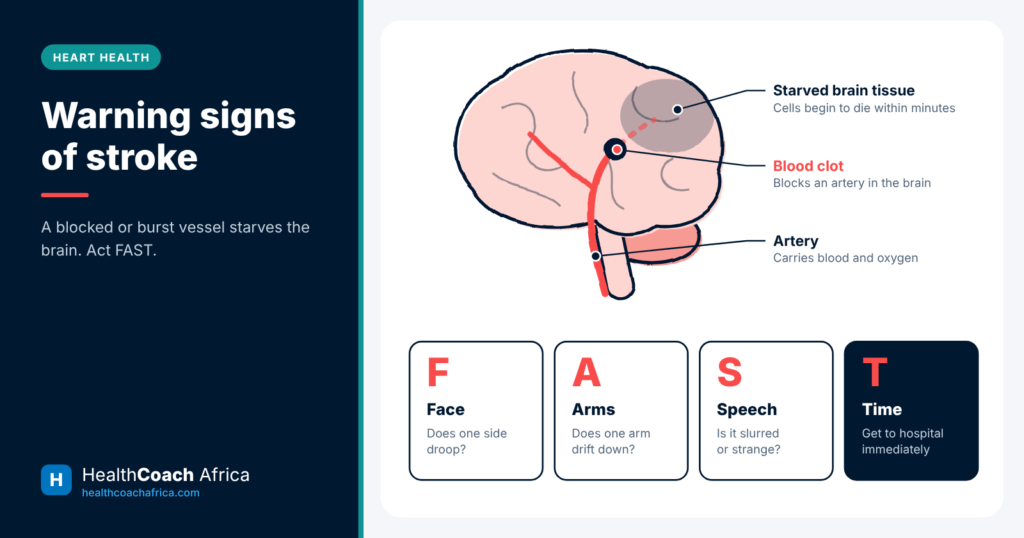
A stroke happens when blood flow to part of the brain is cut off, or when a blood vessel in the brain bursts. Brain cells begin to die within minutes. In Nigeria and across Africa, strokes often strike a decade or more earlier than in Europe or North America, frequently in people who never knew their blood pressure was high. Learning the warning signs of stroke takes two minutes, and it could save the life of someone you love.
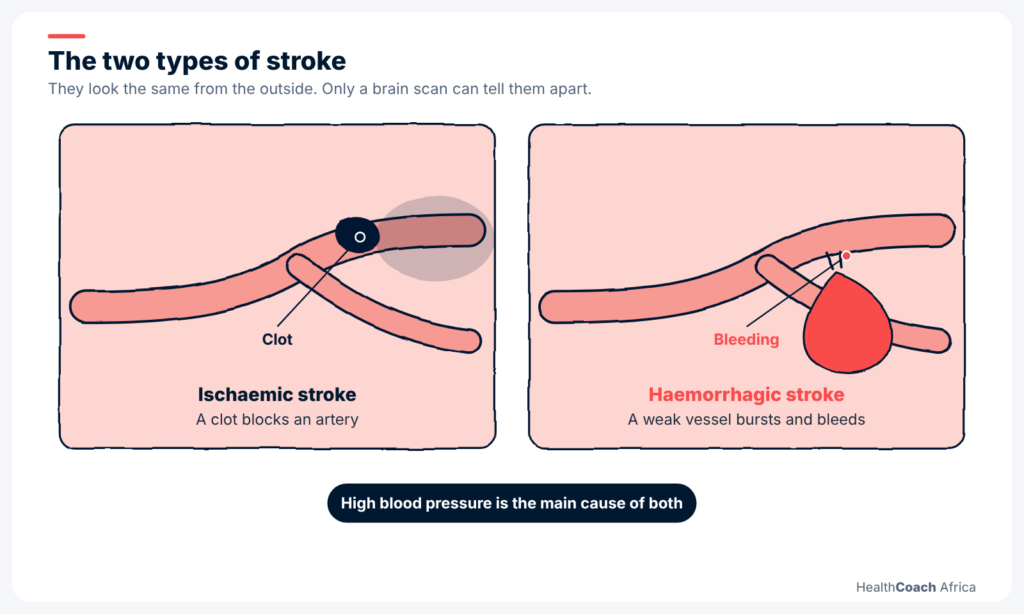
The two types of stroke
Most strokes are ischaemic, which means a clot blocks an artery. The rest are haemorrhagic, caused by bleeding into the brain. Bleeding strokes are more common in Africa than in many other regions, largely because of uncontrolled hypertension.
Both types look the same from the outside. Only a brain scan can tell them apart, which is why hospital care matters and home treatment does not work.
Two Types of Stroke
The warning signs of stroke: use the FAST test
F for Face. Ask the person to smile. Does one side of the face droop?
A for Arms. Ask them to raise both arms. Does one arm drift down or feel weak?
S for Speech. Ask them to repeat a simple sentence. Is the speech slurred or strange?
T for Time. If you see any one of these signs, it is time to get to hospital immediately.
Other warning signs of stroke include:
Numbness or weakness on one side of the body
Confusion or trouble understanding speech
Loss of vision in one or both eyes
Dizziness, loss of balance or trouble walking
A severe headache with no known cause
The key word is sudden. These symptoms appear within seconds or minutes, not over days.
Warning signs of stroke that are often missed
FAST catches most strokes, but not all. Some doctors now teach BE FAST, which adds two earlier letters:
B for Balance. Sudden loss of balance, dizziness or trouble walking.
E for Eyes. Sudden loss of vision, or double vision, in one or both eyes.
In addition, a bleeding stroke often announces itself differently. It may begin with a sudden, severe headache, vomiting, a stiff neck or collapse. Family members sometimes assume the person has fainted or is simply exhausted.
Strokes can also happen during sleep. If someone wakes up with weakness or slurred speech, treat it as an emergency. Tell the hospital the last time the person was seen well, because that time guides treatment.
What to do in the first minutes
Note the time. Doctors need to know when the symptoms started in order to choose the right treatment.
Go straight to a hospital that can do a brain scan, or call 112.
Position the person safely. If they are drowsy or vomiting, lay them on their side with the head slightly raised.
Give nothing by mouth. That includes food, water, aspirin and blood pressure tablets. Swallowing may be unsafe, and aspirin can worsen a bleeding stroke.
Do not wait to see whether the symptoms improve.
Clot-dissolving treatment works only within about four and a half hours of the first symptom. Therefore, every minute counts.
What happens at the hospital
Once you have spotted the warning signs of stroke, knowing the hospital process helps families to cooperate quickly. On arrival, the team will:
Check breathing, blood pressure and blood sugar. Low blood sugar can imitate a stroke.
Arrange a brain scan. A CT scan shows whether the stroke is caused by a clot or by bleeding. Treatment for one can be harmful in the other.
Give clot treatment if suitable. Some patients who arrive within four and a half hours can receive a medicine that dissolves the clot.
Test swallowing. Food and drink are given only when swallowing is safe.
Begin medicines to prevent another stroke. These are chosen once the scan result is known.
Not every hospital in Nigeria has a CT scanner. Therefore, find out now which hospital near your home and workplace offers one. That single piece of information can save an hour on the day it matters.
Mistakes that cost lives
Many families go first to a prayer house, a traditional healer or a medicine shop. Others massage the weak limb or give herbal mixtures. However, a stroke is not a spiritual attack. It is a medical emergency, and each hour of delay destroys more brain tissue and lowers the chance of walking and talking again. Pray on the way to the hospital, not instead of going.
Never ignore a mini-stroke
A transient ischaemic attack, or mini-stroke, causes the same symptoms, but they disappear within minutes or hours. This is not a lucky escape. Instead, it is a warning that a full stroke may follow within days. See a doctor on the same day.
Recovery and rehabilitation
Recovery starts within days, not months. The brain can relearn skills, and the fastest progress usually happens in the first three to six months. However, improvement can continue for years.
Rehabilitation may involve a physiotherapist for movement, a speech therapist for speech and swallowing, and an occupational therapist for daily tasks. Families are part of the team. For example, they can help with exercises, turn a bed-bound relative every two hours to prevent pressure sores and encourage the person to do as much as possible alone.
Low mood is very common after a stroke and slows recovery if ignored. In addition, the medicines started in hospital must continue. These usually include tablets for blood pressure, a medicine to keep blood from clotting and a statin for cholesterol. Stopping them is the most common reason for a second stroke.
Stroke in younger adults
Stroke is not only a disease of old age. In Nigeria, doctors regularly treat patients in their thirties and forties. Besides uncontrolled blood pressure, causes in younger people include:
Sickle cell disease
Heart valve disease and irregular heart rhythm
HIV infection
Stimulant drugs and heavy alcohol use
Complications of pregnancy, such as pre-eclampsia
Smoking combined with some hormonal contraceptives
For that reason, young adults should also know their blood pressure and learn the warning signs of stroke.
How to lower your risk
Most strokes are linked to risk factors that you can change. High blood pressure is by far the most important. Roughly one in three Nigerian adults has hypertension, and many do not know it. For that reason:
Check your blood pressure at least once a year
Take your blood pressure medicine every day, even when you feel well
Cut down on salt, seasoning cubes and processed food
Keep diabetes and cholesterol under control
Stop smoking and limit alcohol
Stay active and maintain a healthy weight
In addition, people with sickle cell disease, an irregular heartbeat or a previous stroke need regular specialist follow-up.
Frequently asked questions
Should I give aspirin while waiting for help?
No. Aspirin helps after a clot stroke, but it can worsen a bleeding stroke. Only a scan can tell the two apart.
Can someone recover fully from a stroke?
Many people do, especially when treatment starts early and rehabilitation is consistent. Others are left with some weakness or speech difficulty, yet still return to an independent life.
Does stroke run in families?
Family history raises the risk, mainly because high blood pressure and diabetes run in families. However, controlling those conditions removes most of the added risk.
Can high blood pressure cause a stroke even if I feel fine?
Yes. Most people with high blood pressure feel completely well. That is exactly why it is dangerous.
What should I keep ready at home?
Keep a list of each family member’s medicines and conditions, the name of the nearest hospital with a scanner and the emergency number 112.
One conversation that saves lives
Teach the warning signs of stroke to everyone in your household, including teenagers and house helps. They are often the ones at home when it happens. Agree in advance where you would go and how you would get there.
Getting help
Share the warning signs of stroke with your family today, and save 112 on every phone in the house. HubPharm pharmacists can review your blood pressure medicines and arrange refills so that you never run out. You can also read how a heart attack differs from cardiac arrest, or see the World Health Organization’s page on cardiovascular diseases.
Please follow and like us:
Views:32
Related Posts:
Normal Blood Pressure Reading: What Your Numbers Mean You have two numbers and no idea what they mean. Worse, you searched them and found an American page telling you that 134 over 86 is Stage 1 hypertension, while your doctor in Lagos looked…
Diabetes in Nigeria: Why Blood Sugar Control Fails Diabetes in Nigeria does not usually fail in the clinic. Among people who reach a specialist and stay in care, control is often reasonable. It fails in the years before anyone tests you, and it…
Triple Negative Breast Cancer: What It Means for Treatment If your report says triple negative, you have probably already searched the phrase and found something frightening. Triple negative breast cancer is more aggressive than other types, and there is no point pretending otherwise. What…
High Blood Pressure in Nigeria: Why Treatment Stops Working Most people who lose control of high blood pressure in Nigeria were never lost to the health system. They were diagnosed. They collected a prescription. Many even took the tablets for a while. Then something…